

Five ways to cut pump energy, and when each one fits
Right-sizing, variable speed, impeller changes, parallel pumps and running near the best efficiency point. Each has a place, and each has limits.
Compare the options
| Option | Best when | Watch for |
|---|---|---|
| 1. Avoid oversizing | Choosing a new pump or replacing an old one | Safety margins add up. A pump sized well above the duty runs throttled for its whole life. |
| 2. Variable speed drive | Flow demand changes, and friction is a large share of the head | Needs a motor and bearings suited to the speed range, and the lowest speed must still make the static head. |
| 3. Reduce the impeller diameter | Flow is constant but the pump is too big | Cannot follow changing flow. Keep the cut within the maker's limit, and keep the impeller balanced. |
| 4. Pumps in parallel | Flow varies and static head is a large share of the total | Check that the pumps share the load, and that one pump alone can cover the minimum flow. |
| 5. Run near best efficiency | Any system | Efficiency falls and radial load rises when the pump runs far from its design point. |
1. Avoid oversizing
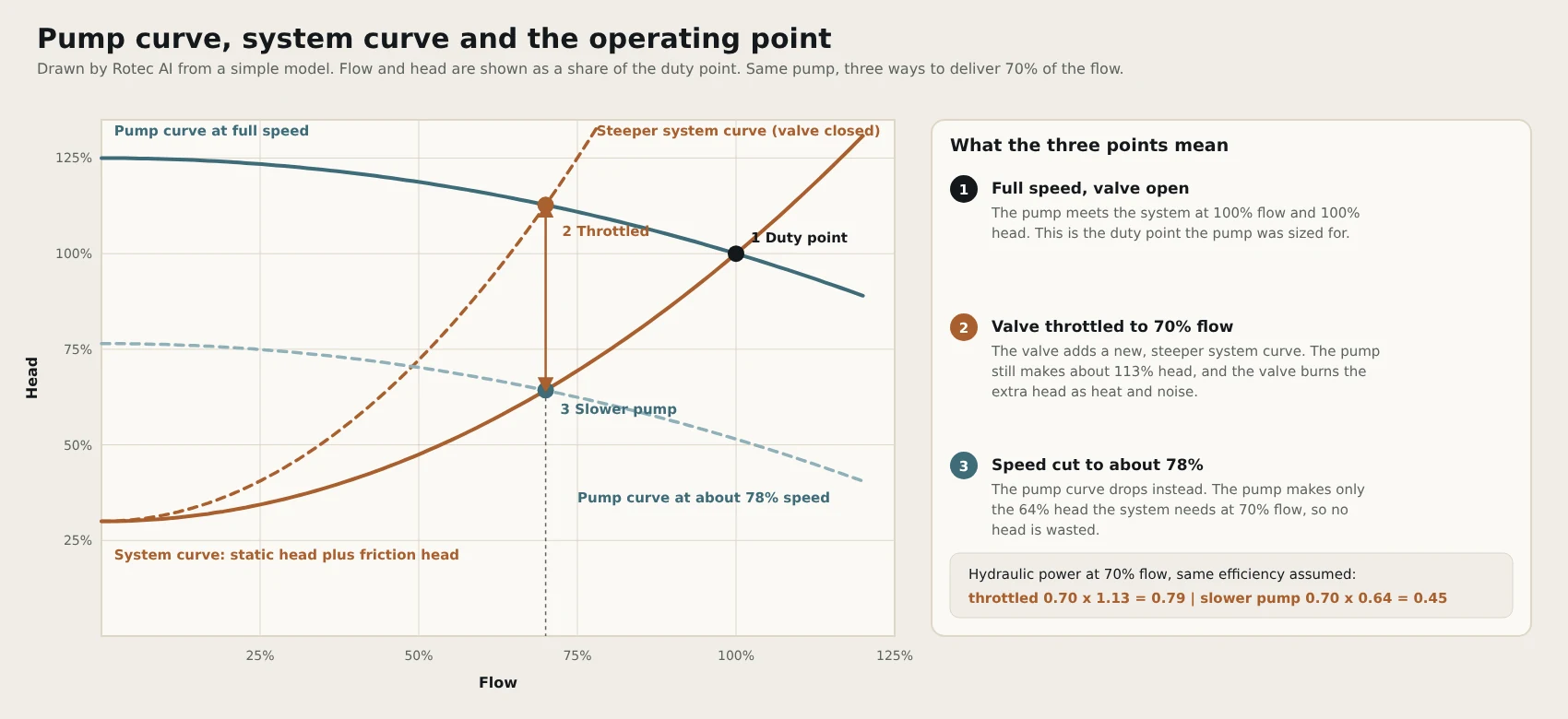
An oversized pump forces the valve to throttle. The pump still makes the extra head, and the valve turns it into heat and noise. The first fix is a pump or impeller that matches the real duty. The worked example in the next topic shows what this costs in money.
2. Variable speed drives
A drive changes the motor speed over a continuous range. When the pump slows, less energy goes into the liquid, so less energy has to be throttled or bypassed. Besides the energy saving, a drive gives tighter control of flow or pressure, lower start-up current, and lower wear because bearings and seals run slower. It can also remove control valves, bypass lines and heavy starters.
3. Reduce or trim the impeller
If the pump is too big for a constant duty, a smaller impeller or a trimmed one moves the pump curve down. Trimming is cheap, but it cannot follow a changing flow, and the trim should be the same all round to keep the impeller balanced. Trimming beyond the limit the maker allows reduces efficiency and can worsen cavitation and vibration. Fitting a new smaller impeller is better than trimming, but it costs more.
4. Pumps in parallel
Two or three smaller pumps can follow a varying demand by switching pumps on and off. Their combined curve is found by adding the flows at each head. This suits systems with a high static head, where slowing one pump may not be possible. Avoid running extra pumps when one would do; an auto-start spare or a small booster pump in the problem area often removes the need.
5. Stay near the best efficiency point
Pick the pump and the operating point so the pump runs close to the flow where its efficiency peaks. Away from that point, the pump loses efficiency, and the radial load on the shaft rises, so seals and bearings wear faster.
Other items on a pump energy checklist
- Make a water balance. Pumping less water saves more than pumping it efficiently.
- Reduce losses in the system: partly closed valves, fouled strainers, undersized pipes.
- Fix leaks and recirculation lines that run all the time.
- Replace old pumps whose efficiency has fallen with wear. A worn pump uses more power for the same flow.
- Track power, flow and pressure over time. A drift in the ratio is an early sign of wear.