

Affinity laws: why a small speed reduction saves a lot of power
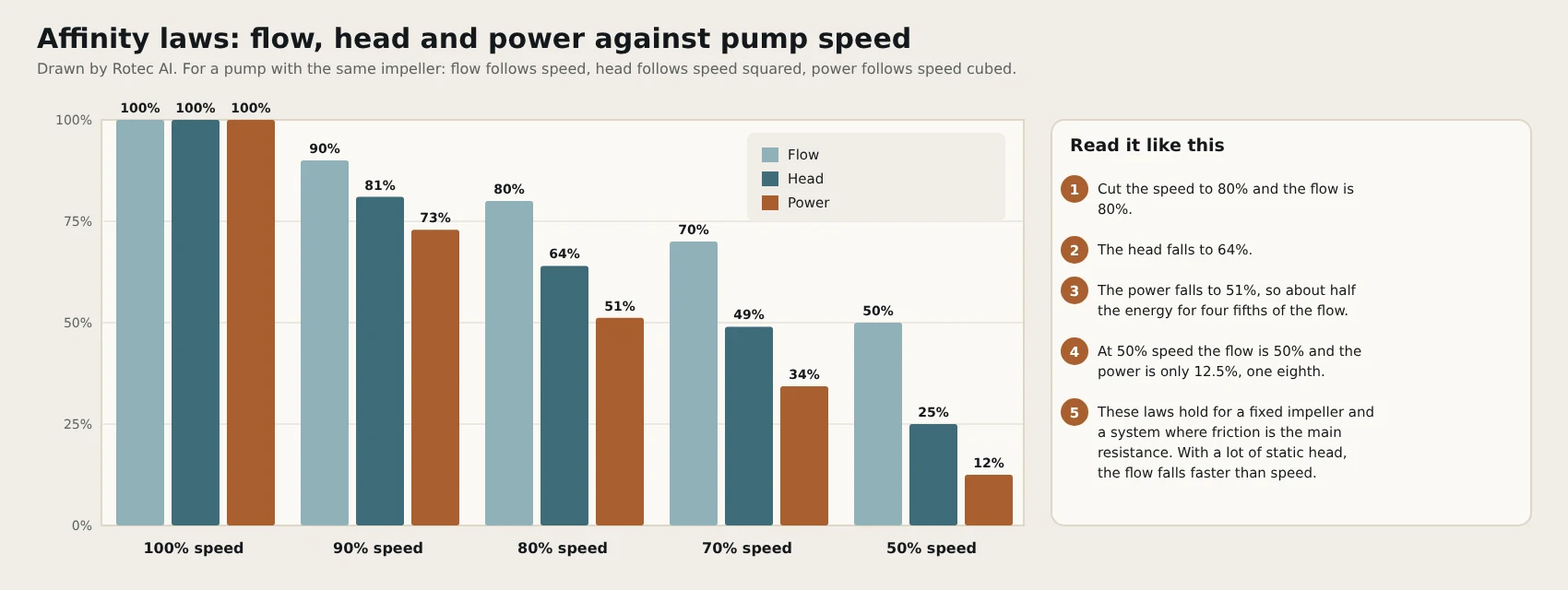
For a centrifugal pump, flow follows speed, head follows speed squared and power follows speed cubed. That is why slowing a pump is the most efficient way to reduce flow.
The three laws
When the speed of a centrifugal pump changes and the impeller stays the same, the flow, the head and the power change in a fixed way. These are the affinity laws. They let you predict what a speed change will do before you make it.
| Quantity | Rule | Example: speed halved from 1480 to 740 rpm |
|---|---|---|
| Flow Q | Q1 / Q2 = N1 / N2 | 100 m3/h becomes 50 m3/h |
| Head H | H1 / H2 = (N1 / N2) squared | 100 m becomes 25 m |
| Power P | P1 / P2 = (N1 / N2) cubed | 50 kW becomes 6.25 kW, one eighth |
Impeller diameter follows the same pattern
Trimming the impeller changes the tip speed in the same way, so the same laws apply with diameter in place of speed: flow follows the diameter, head follows its square and power follows its cube.
| Quantity | Rule | Example: impeller trimmed from 8 to 6 inch |
|---|---|---|
| Flow | Q1 / Q2 = D1 / D2 | 100 m3/h becomes 75 m3/h |
| Head | H1 / H2 = (D1 / D2) squared | 100 m becomes 56.25 m |
| Power | P1 / P2 = (D1 / D2) cubed | 5 kW becomes about 2.1 kW |
Limits you should respect
- The cube law gives the best case. It holds well when the system is mostly friction. With a large static head the flow falls faster than the speed, and at low speed the pump may not make enough head to deliver any flow.
- Efficiency falls a little at lower speed. A reduction to half speed typically costs one or two points of efficiency, which is small beside the power saving.
- For a diameter change of more than about 5%, the squared and cubed relations become less accurate. Use the maker's curves for the final numbers.
- Check the lowest speed the pump, seals, bearings and motor cooling will accept, and avoid speeds that match a critical speed or a structural resonance.
Why this is the basis of pump energy saving
Because the power falls with the cube of the speed, running a pump at 80% of the speed uses about half the power. If the process needs less flow for most of the time, controlling the flow by speed is always more efficient than throttling with a valve.