

Pump curve, system curve and operating point
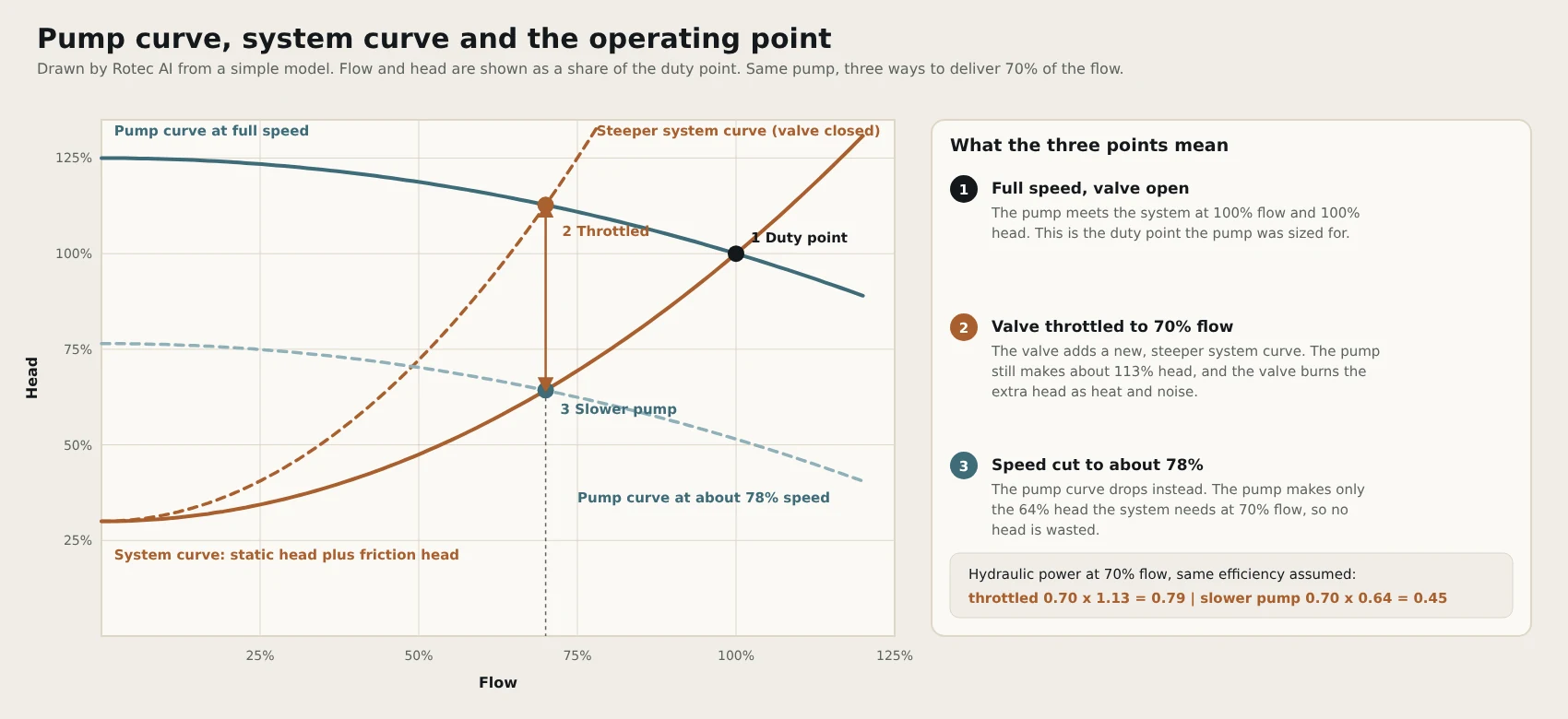
A pump works where its curve crosses the system curve. Knowing both curves tells you why throttling wastes energy and why a slower pump can do the same job.
Head: what the pump has to overcome
To move liquid from one place to another, a pump must overcome two things. Static head is the difference in height between the supply and the destination, and it does not change with flow. Friction head is the resistance of the pipe, fittings, valves and equipment, and it grows with the square of the flow rate. Together they make the system curve.
| Part of the head | What sets it | How it changes with flow |
|---|---|---|
| Static head | Height difference between the supply and delivery levels, plus any difference in pressure | Constant at every flow |
| Friction head | Pipe size and condition, number of fittings and valves, liquid, flow | Rises with flow squared: double the flow, about four times the friction head |
| System curve | Static plus friction | Starts at the static head and curves upward |
The pump curve and the operating point
A centrifugal pump gives most head at no flow, and less and less head as the flow rises. The pump settles where its curve crosses the system curve. This is the operating or duty point. If the system resistance rises, the flow falls, and the head the pump can give is limited by its curve.
Static-heavy and friction-heavy systems
| System | What the curve looks like | What it means for control |
|---|---|---|
| Mostly static head, for example lifting water to a high tank | Nearly flat system curve | A small change in pump head changes the flow a lot. Slowing the pump can stop the flow altogether once its head falls below the static head. |
| Mostly friction head, for example a closed circulation loop | Steep curve from zero | Flow follows pump speed closely, so speed control works well and the affinity laws apply. |
Reading a vendor curve
- Vendor head and flow curves are normally measured on clean water. Viscous or dirty liquids change them.
- The same chart usually shows efficiency, power and the net positive suction head the pump needs (NPSHR) against flow.
- One casing often has several impeller diameters, each with its own curve. The choice is a match between the curve and the system you have.
- Where the application has several duty points, the largest flow or head sets the rated duty, so check that the pump is also efficient at the points where it runs most of the time.
Why this matters for bearings and seals
Away from its best efficiency point, a centrifugal pump has uneven pressure around the impeller. That puts a radial load on the shaft, which shows up as shaft deflection, seal wear and higher bearing loads. Running at the point the pump was designed for is good for the electricity bill and for bearing and seal life.