

Belt conveyors
Take-up and tensioning: why the belt must be tight enough, and no tighter
Quick answer
The jobs of a take-up, the main types, the travel needed and how to set tension for splicing.
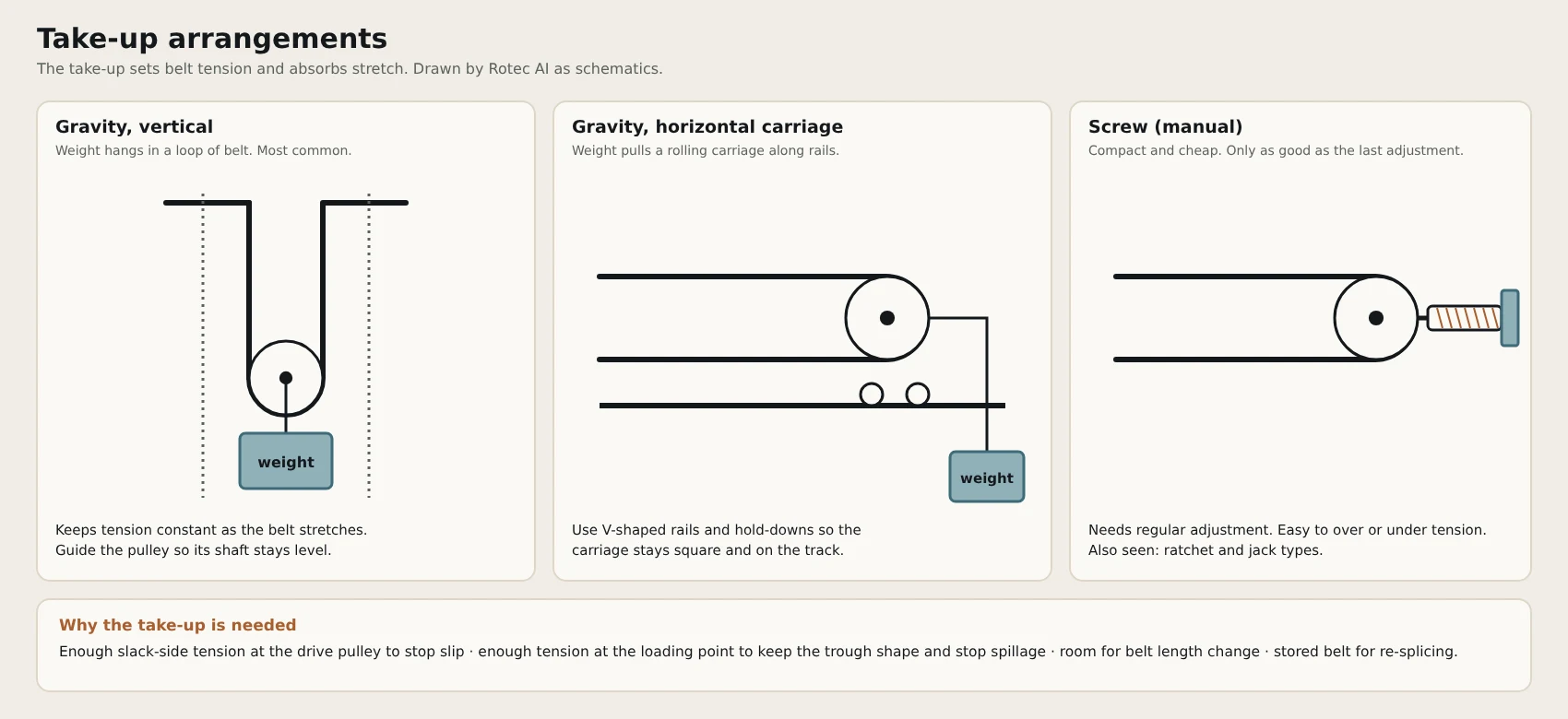
What the take-up does
- Keeps enough tension on the slack side so the belt does not slip on the drive pulley
- Keeps enough tension at the loading point and along the run so the belt holds its trough shape and does not spill
- Makes up for belt length change from stretch and temperature
- Stores belt so a repair needs one splice, not two
Which type
| Type | Strength | Weakness |
|---|---|---|
| Gravity (vertical, horizontal or incline) | Holds tension almost constant; most common | Needs space; the carriage must stay square and on its track |
| Powered (hydraulic, electric, pneumatic) | Can vary tension for starting and running | More parts to maintain |
| Screw, ratchet or jack | Compact and low cost | Tension is only as good as the last adjustment; usually too high or too low |
Take-up travel needed (indicative)
| Carcass material | Manual take-up, full tension | Automatic take-up, full tension |
|---|---|---|
| Nylon | 4% of centre distance | 3% |
| Polyester | 2.5% | 1.7% |
| Aramid | 2% | 1.5% |
| Fibreglass | 1% | 0.5% |
| Steel cord | Not listed here | About 0.3% |
Where to start the take-up
Fabric belts stretch, so set a fabric belt with about 90% of the travel available for lengthening and 10% for shortening. A steel-cord belt stretches much less, so about 25% is set for lengthening and 75% for shortening. The figures come from a belt maker’s guide and are indicative; confirm with the belt supplier for your belt.
Tensioning the belt for a splice
- The final splice is made at the point where the belt is pulled tight and clamped, using a powered pull device, with load cells or scales to read the tension.
- Pull until the reading equals or slightly exceeds the recommended take-up tension, and allow belt length to position the counterweight afterwards.
- With the counterweight on, tie the take-up off about 150 to 200 mm above its running position, pull the belt until the take-up lifts and the ties go slack, then splice with as little slack as possible.
- A belt pulled from one direction only needs more splicing tension than one pulled from both. A slope belt spliced at the top needs more than one spliced at the bottom. A belt with a backstop that cannot be released must be pulled only in the running direction.
- Too much tension on a short belt can harm the pulley shafts and bearings. A gravity take-up set too close to its stop can damage the structure.
Takeaway. Set tension from a calculation, not from feel. Too low causes slip and spillage. Too high shortens splices, belt and pulley bearings.
Put it to work in the tool