

Belt conveyors
The loading zone: chutes, skirtboards and impact protection
Quick answer
Why the loading point sets belt life, and how to land material on the belt with little impact and little spillage.
Why it matters
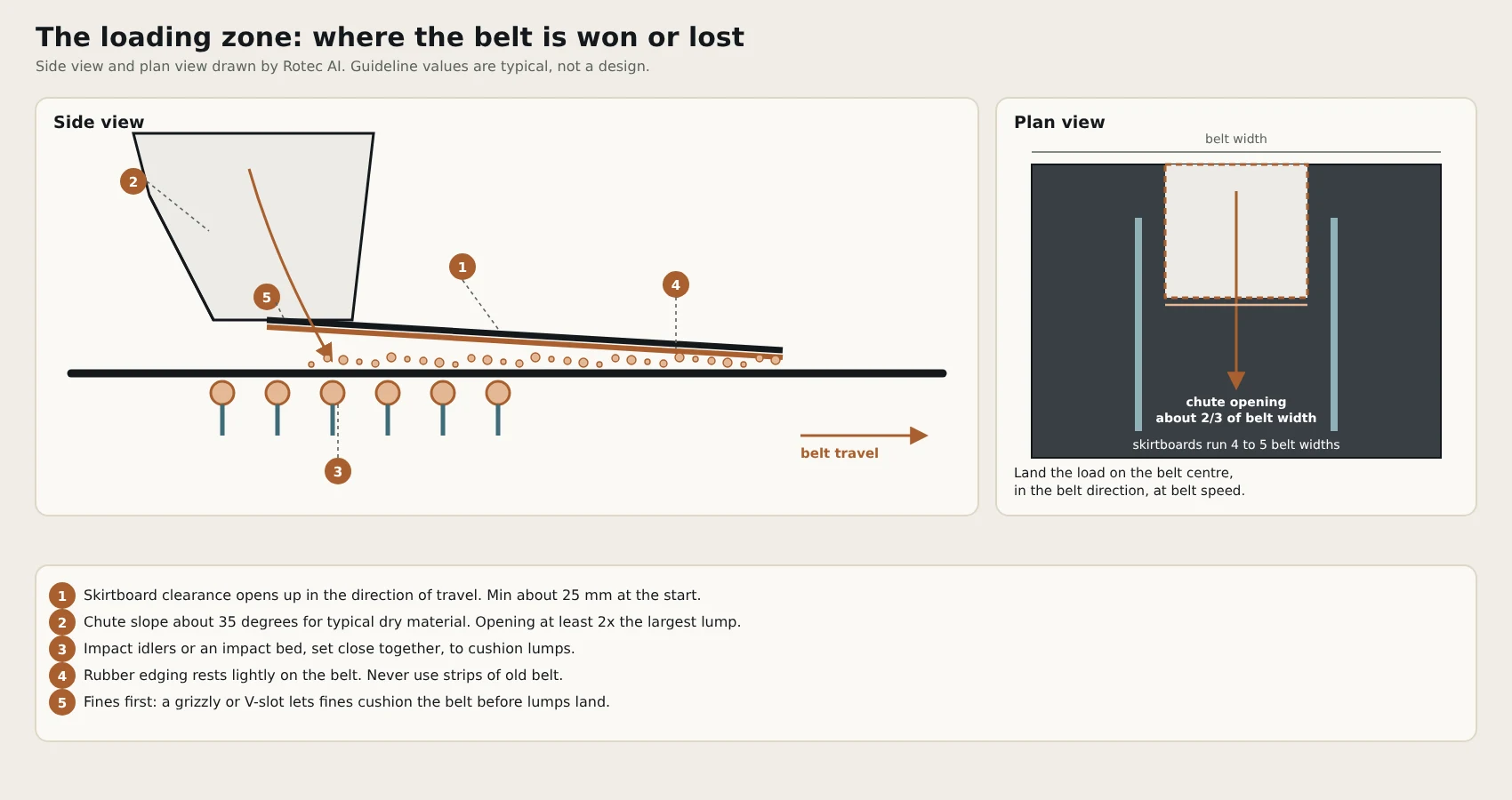
At the loading point the belt takes most of its abrasion and almost all of its impact. The ideal is for material to leave the chute at the same speed and in the same direction as the belt, with as little drop as possible. Material landed off centre makes the belt slide sideways as the load settles into the trough, so a tracking problem is often a loading problem.
Chute rules of thumb
- Receiving opening wide enough to catch material from the previous belt or feeder, set by the path the material follows.
- Never narrower than about twice the largest lump when fines are present, or about 3.5 times when lumps are uniform.
- Discharge width no more than about two-thirds of the belt width.
- Chute slope about 35 degrees for typical dry material such as rock or coal. It varies with the material, speed and chute length.
- Expect to adjust in the field: the ideal chute is found by trial.
Skirtboards
- Skirtboards shape and settle the load after the chute. Typical length is 4 to 5 belt widths, and longer if the belt speed is high or the material is lumpy.
- Keep steel at least about 25 mm clear of the belt, with the gap increasing in the direction of travel so nothing wedges.
- Seal the gap with a rubber strip fixed to the outside of the skirt. It should touch the belt lightly, with no fabric inside, and must never be a strip of old belt.
Reducing impact
- Rubber-disc or semi-pneumatic idlers, set close together, cushion the belt and prevent material from crowding under the skirt.
- An impact bed supports the whole loading zone and stops the belt sagging between rolls.
- A grizzly (fanned row of bars) or a V-slot at the base of the chute lets fines land first and act as a cushion for the lumps.
- A curved chute reduces abrasion and gouging by matching material speed and cutting the drop. It usually pays for itself in reduced wear; flow modelling software is used to design one.
Takeaway. Fix the loading zone before you chase tracking or bearings. Centre, direction, speed and cushioning set the rest of the belt’s life.
Put it to work in the tool