

Belt conveyor basics: parts, forces and layouts
What a belt conveyor is made of, how it moves material and why belt, drive, take-up and loading point have to be designed together.
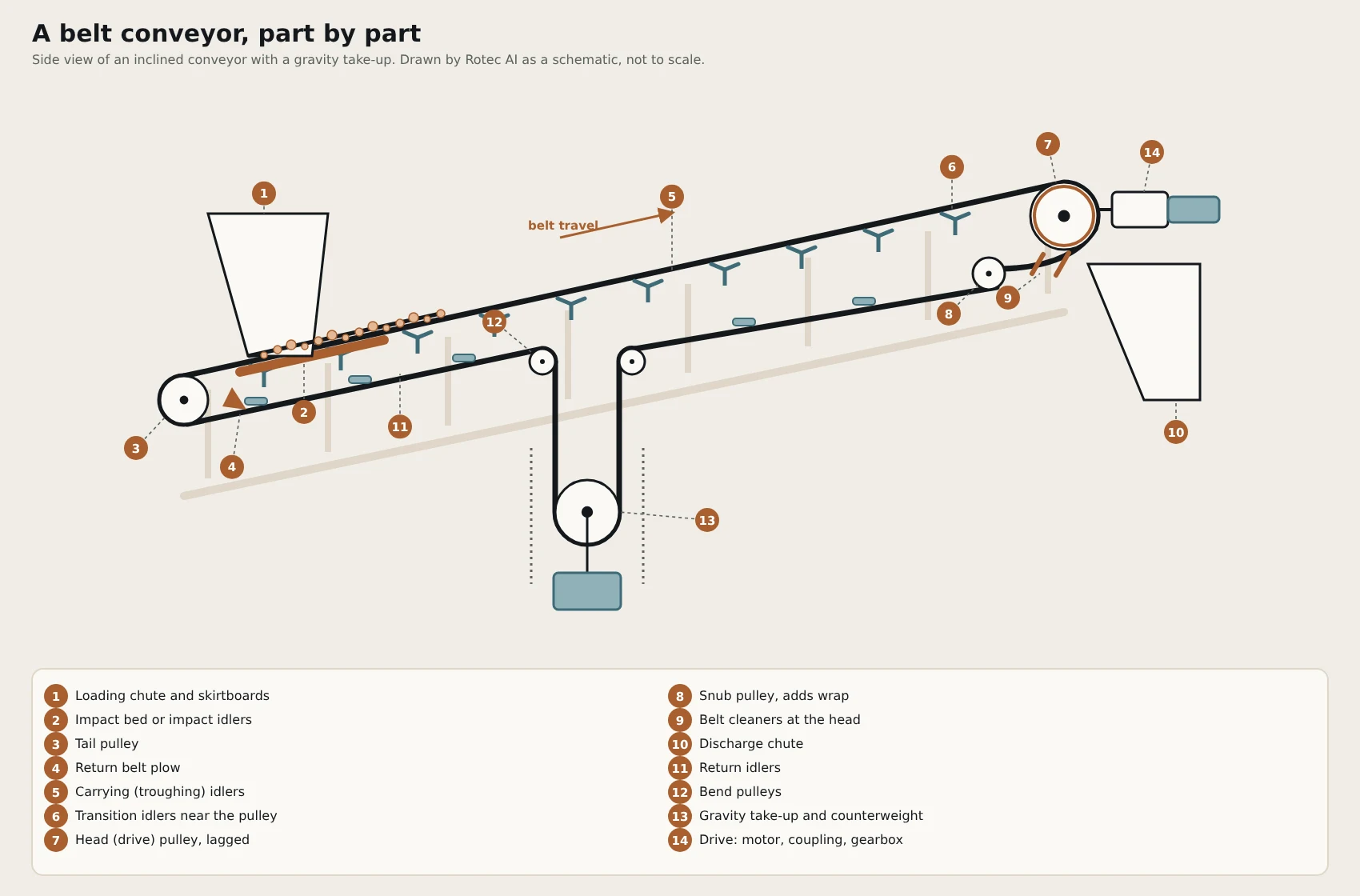
How it works
Material is fed from a hopper or bin onto the belt at the loading point. The loading point is built to settle the load in the middle of the belt with little wear and spillage. The belt is carried by idlers on the top side and returned on idlers on the bottom side. Pulleys at each end turn the belt around, and in most conveyors the head pulley also drives it. The material settles at its dynamic angle of repose as it moves along, and it leaves over the head pulley.
Main parts
- Belt with top cover, carcass and bottom cover, joined with a splice
- Pulleys: head, tail, snub, bend and take-up, with lagging on the drive pulley
- Carrying idlers (troughing, impact, training) and return idlers
- Take-up to keep the belt tight
- Chutes and hoppers, skirtboards and seals
- Covers, belt cleaners and protection devices
What loads the belt
Belt tension comes from four things: lifting or lowering the material, friction in the idlers, drive and accessories, friction of the material itself, and the force needed to speed the material up to belt speed as it lands. The drive force reaches the belt only through friction on the drive pulley, so the tension has to be higher on the tight side than on the slack side as the belt leaves the pulley.
Three layouts, and special belts
| Layout or belt | Where it is used | Note |
|---|---|---|
| Horizontal | Short transfers, feeders | Simple to design; drive usually at the discharge end |
| Incline | Raw material, clinker and bulk handling | Often needs a backstop if the conveyor can run back when loaded |
| Decline | Down slopes | The drive acts as a brake; the best drive position is the loading end |
| Moulded cleat or pocket belt | Steep angles, up to vertical | Fewer parts for steep lifts; can be twisted to turn the discharge |
| Totally enclosed (pipe) belt | Dusty or tightly curved routes | Covers the load and can climb steeper than a standard belt |
| Sandwich belt | Steep lifts with standard parts | Holds the load between two belts under pressure |
How full the belt can be
How much material the belt can carry safely depends on the angle of repose and the surcharge angle, which is the angle the material takes while it rides on a moving belt. The surcharge angle is usually 5 to 15 degrees less than the angle of repose, and for some materials up to 20 degrees less. Flowability depends on lump and particle size and shape, surface roughness, the mix of fines and lumps, and moisture. Keep a clear gap between the material and the edge of the belt. A common rule is about 5.5% of the belt width plus 23 mm, which is roughly 73 mm on a 900 mm belt.