

Oil analysis
What oil analysis tells you: wear, contamination and oil condition
Quick answer
One oil sample answers three questions: is the machine wearing, is the oil dirty, is the oil still good? Learn which test answers which question, and what each machine type needs.
Why test used oil
Oil carries the evidence of what is happening inside a machine. Wear particles, dirt, water and chemical change all end up in it. Testing it on a schedule gives early warning, lets you change oil by condition instead of by the calendar, and helps you confirm that the right oil went in. It works best alongside vibration and thermography, because it sees things those methods cannot, such as a wrong top-up oil or slowly rising water.
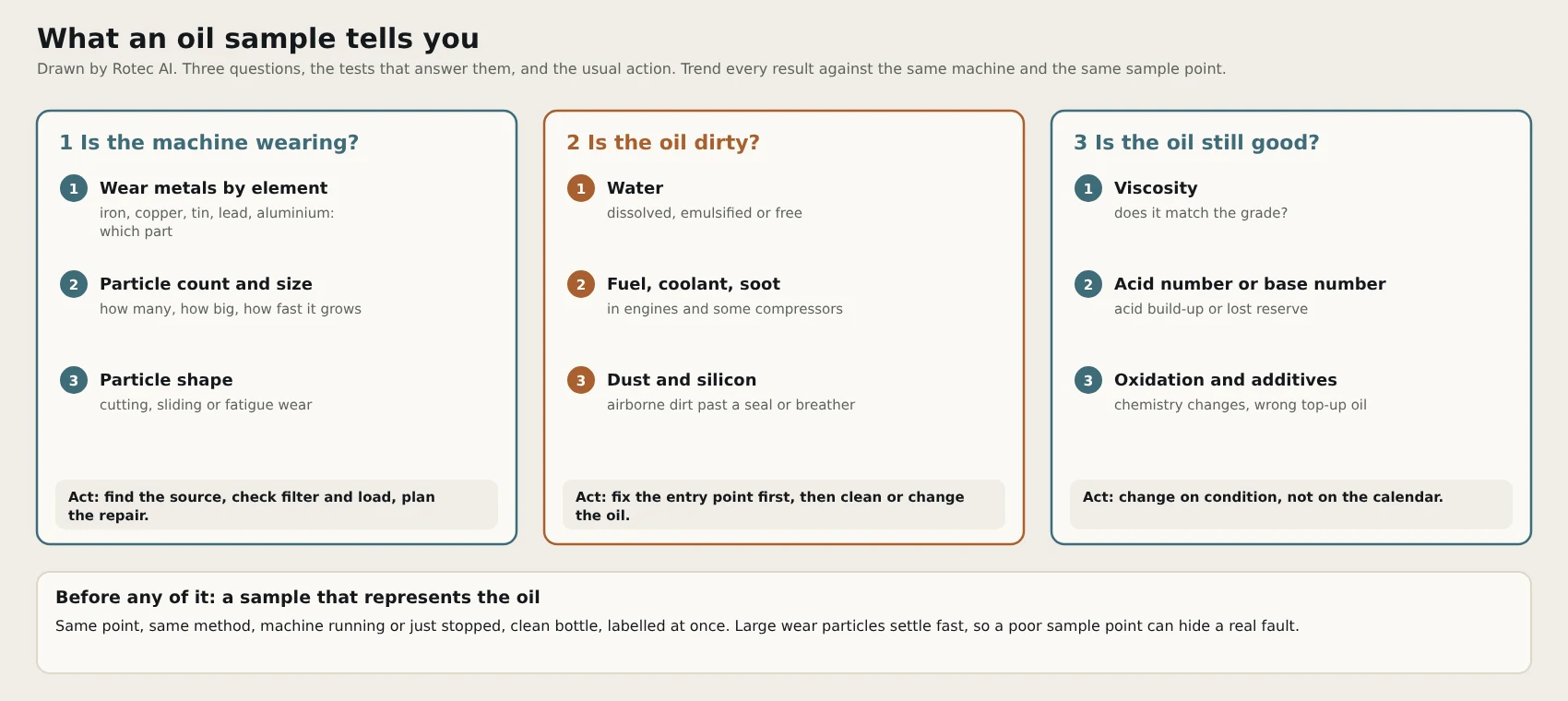
Parameters and the tests that measure them
| Question | Parameter | Common tests | What a change usually means |
|---|---|---|---|
| Wear | Fine wear metals (ppm) | Optical emission or plasma spectroscopy | A part is wearing; the element points to which part |
| Wear | Large wear metals | Filter-based spectroscopy, ferrous density, ferrography | Severe wear, often later than the fine-metal rise |
| Wear | Particle count and size | Optical count, direct imaging | Wear or dirt entering; filter bypassing |
| Wear | Particle shape | Direct imaging, ferrography | Cutting, sliding or fatigue wear |
| Contamination | Water | Infrared, Karl Fischer titration, crackle test | Seal, breather, condensation or cooler leak |
| Contamination | Fuel, glycol (coolant), soot | Headspace sensor, flash point, infrared | Injector, coolant or combustion problem |
| Contamination | Sand and dirt (silicon) | Spectroscopy, particle count | Dirt ingress past seals, breathers or filters |
| Oil condition | Viscosity | Kinematic viscometer | Wrong oil, fuel dilution, oxidation or thickening |
| Oil condition | Acid number or base number | Titration, infrared | Oxidation and acid build-up, or loss of reserve alkalinity |
| Oil condition | Oxidation, nitration, additives | Infrared | Oil ageing, overheating, wrong or depleted oil |
What each machine type cares about most
| Machine | Look first at | Why |
|---|---|---|
| Diesel and gas engines | Viscosity, fuel dilution, soot, base number, coolant | Combustion products and coolant leaks attack the oil quickly |
| Gearboxes | Wear metals, particle count, viscosity, water | Gears shed large particles; viscosity must hold the film |
| Hydraulic systems | Particle count, water, viscosity | Cleanliness decides valve and pump life |
| Turbines and compressors | Oxidation, acid number, water, varnish | Long oil life, so ageing and water matter most |
Where it pays off
- Avoiding oil mix-ups: checking the grade and chemistry of new oil and of top-ups.
- Contamination control: finding the entry point of water, dust or fuel before damage.
- Condition-based oil change: changing oil when tests say so, not when the calendar says so.
- Failure analysis: finding out what failed and why, using particle shape and composition.
Takeaway. Match each test to the question it answers, and trend every result against the same machine and sample point. One reading is a snapshot, a trend is the evidence.
Put it to work in the tool