

Oil analysis
A six-step oil condition monitoring blueprint
Quick answer
From clean storage to root cause: six steps that take oil monitoring from sampling to action. Steps 1 to 3 are done in the field, steps 4 to 6 in the lab and the office.
The idea
Oil condition monitoring covers the whole life of the lubricant, from the day it is stored to the lab report and the action that follows. Following a fixed six-step routine helps a maintenance team catch contamination early, find the root cause of machine wear, and avoid costly downtime. It also supports lower total cost of ownership, because oil is changed when it needs it and not before.
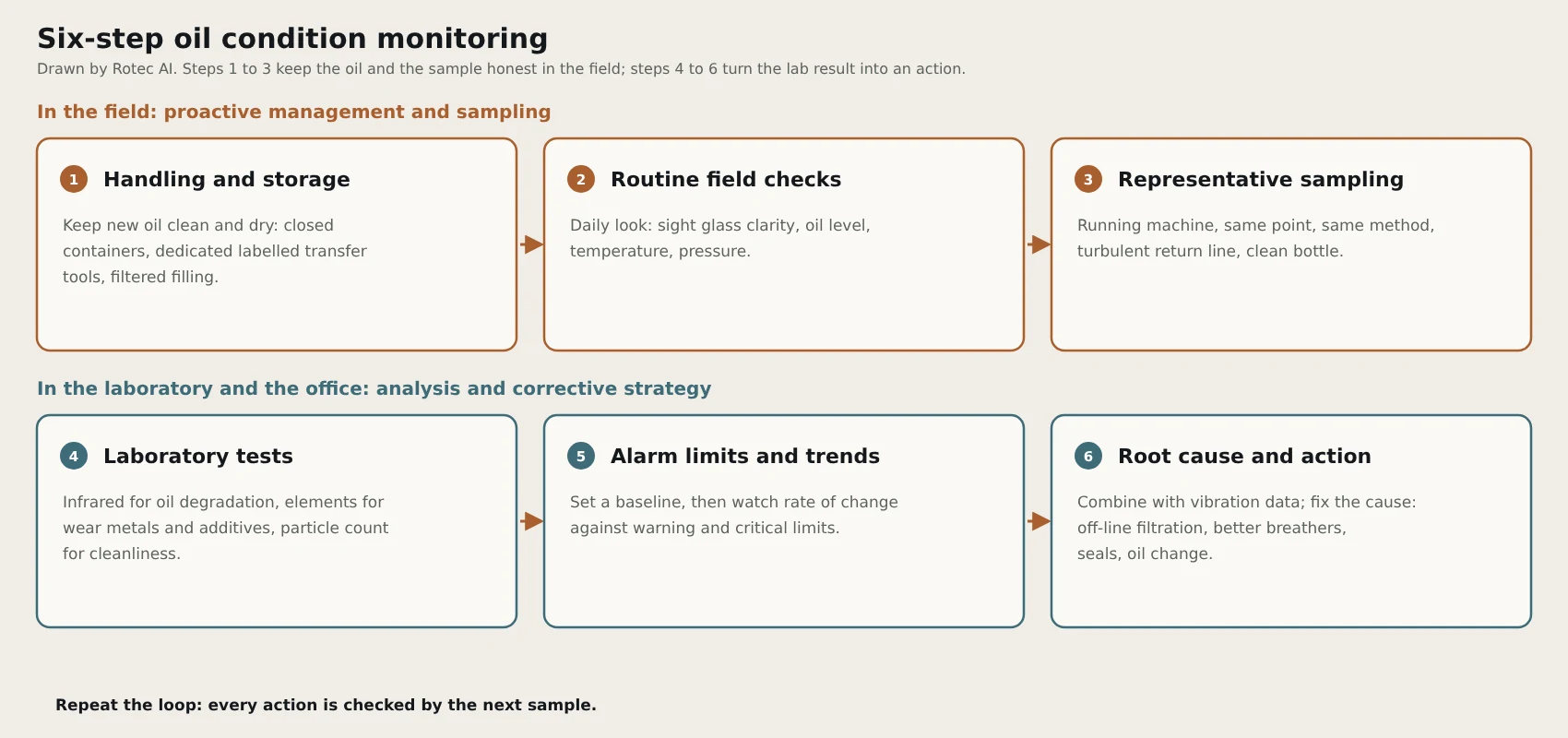
The six steps
| Step | What to do | Why |
|---|---|---|
| 1. Handling and storage | Protect new oil from dust and moisture with clean, correctly labelled transfer tools and closed containers | Dirty new oil starts the problem before the machine runs |
| 2. Routine field checks | Daily look at sight glass clarity, oil level, temperature and system pressure | Sees changes between samples |
| 3. Representative sampling | Take samples with the machine running from a turbulent return line, using a vacuum pump or a sampling valve and a clean bottle | A sample must represent the oil in the system |
| 4. Laboratory control | Infrared for degradation, elemental spectroscopy for wear metals, particle counting for cleanliness | Each test answers a different question |
| 5. Alarm limits and trends | Set a baseline, then watch the rate of change across critical parameters against warning and critical limits | A trend shows the direction; a single number does not |
| 6. Root cause and corrective action | Combine with vibration data; use off-line filtration or better breathers to remove the cause of the contamination | Fixing the cause stops the next alarm |
What goes wrong most often
- Samples taken from the bottom of the sump or from a dead leg, which hide the real condition.
- Limits copied from a generic table, with no baseline for the machine itself.
- Treating a lab report as the end, when the action in step 6 is what saves money.
Takeaway. Oil monitoring pays when it is a loop: clean oil in, honest samples out, trends against a baseline, and a fix for the cause. Without step 6 it is only record keeping.
Put it to work in the tool