

Misalignment: when perfect alignment is still wrong
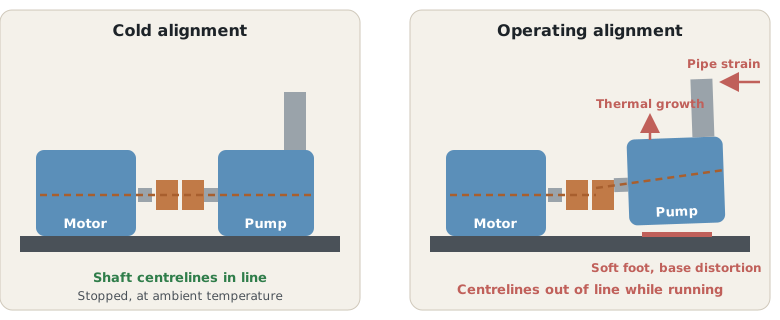
Cold alignment does not always represent operating alignment. A machine aligned to tolerance while stopped can run misaligned once thermal growth, pipe strain, soft foot or base movement shift the shafts. Misalignment often raises 1X and 2X vibration with some axial vibration, but a 2X peak alone does not prove it. Confirm with phase, operating conditions and inspection.
A machine can be aligned and still run misaligned
A motor and a pump can be aligned to tolerance during maintenance and still run out of line once they reach normal working conditions. Shaft alignment is not a fixed property. It is a relationship between two machines that can change when they heat up, when pipework loads them, and when their frames and bases move.
Cold alignment is not operating alignment
The alignment set while the machine is stopped and cold is the cold alignment. What matters to the bearings, seals and coupling is the alignment while the machine is doing its job. The two can differ.
Four things that move the shafts
| What moves the shaft | What happens | How to check |
|---|---|---|
| Thermal growth | Casings, supports and shafts expand by different amounts when hot, so the shaft centres move between stopped and running | Use the maker's hot offset, or record the change between cold and hot and set the cold alignment to suit |
| Pipe strain | Connected pipework pushes or pulls the casing, so the machine shifts when the pipe is joined or when the line heats, fills or pressurises | Watch the coupling with dial indicators while the flange bolts are loosened one at a time, and compare with the site limit |
| Soft foot | A foot that does not sit flat twists the frame when it is tightened, so the alignment changes as bolts are tightened | Measure the gap at each foot and run a bolt-loosening test before the final alignment |
| Baseplate and structure | A flexing baseplate, poor grout, a loose foundation or a heated support lets the machine move under load or temperature | Inspect the base, the grout and the hold-down bolts, and look for movement between stopped and running |
Cold and operating alignment
What the vibration may show
- Raised 1X and 2X running-speed lines are common.
- Axial vibration is often higher than usual, especially with angular misalignment.
- Phase measured across the coupling is the most useful extra evidence. In the commonly used rules, the two sides of the coupling tend to move out of step in the radial direction for parallel offset, and in the axial direction for angular misalignment.
- Repeated bearing or seal failures with a one-sided wear pattern point the same way.
A 2X peak is a clue, not a verdict
- A 2X peak alone does not confirm misalignment. Looseness, soft foot, resonance and electrical causes can raise the same line.
- Confirm with phase, with the operating conditions at the time of the reading, and with a mechanical inspection.
When bearings or seals keep failing
Replacing a failed bearing or seal can restore running. If the shaft alignment changes under operating conditions, the stress that failed the first part is still there and the next one fails the same way. A repeating failure is a sign to look at the conditions, not only at the part.
What to investigate, in order
| Step | Check | Why |
|---|---|---|
| 1 | Alignment under operating conditions: hot where the process is hot, and loaded | The stopped result may not describe the running machine |
| 2 | Thermal growth and the maker's alignment offsets | The cold target should allow for the growth |
| 3 | Soft foot and baseplate condition | Correct these before any final alignment |
| 4 | Pipe strain and other external loads | Loads from the connected pipe can undo a good alignment |
| 5 | Vibration spectrum and phase, at the same operating condition | Separates misalignment from look-alike faults |
| 6 | The failed part: wear track, seal face, fretting | The damage shows how the load acted |
The aim
The aim is not to align two shafts while the machine is stopped. It is to keep the alignment acceptable while the machine runs its normal duty.
A question for your own plant
When bearings or seals fail again and again, how often is the cause investigated before the part is replaced? Count the repeat failures on one asset over a year. They show where the real cause is still unfound.
Limits to keep in mind
- Follow site lock-out rules for every check that needs the machine stopped.
- Use the maker's alignment offsets and tolerances where they exist. Figures in guides are general.
- Do not diagnose from a single spectrum. Compare readings over time and across operating states.
Questions
Can a machine be perfectly aligned and still be misaligned in operation?
Yes. Alignment is usually set while the machine is stopped and cold. Thermal growth, pipe strain, soft foot and base movement can shift the shafts relative to each other once it is running, so cold alignment does not always represent operating alignment.
What does misalignment look like in a vibration spectrum?
Often raised 1X and 2X running-speed components, frequently with higher axial vibration. A 2X peak alone is not proof, because looseness, soft foot, resonance and electrical causes can raise the same line. Phase measurements and the operating conditions help confirm it.
Why do bearings or seals fail repeatedly on one pump?
If the shaft alignment changes under operating conditions, the stress that damaged the first part remains after it is replaced. Check alignment under operating conditions, thermal growth and the maker's offsets, soft foot and baseplate, pipe strain, and the spectrum with phase.
How do I check for pipe strain?
With dial indicators on the coupling, loosen the flange bolts one at a time and watch for movement. Compare the movement with your site or maker limit. Follow lock-out and safety rules.
Should soft foot be corrected before or after alignment?
Before. Correct and verify soft foot first, then do the final alignment, otherwise tightening the bolts can change the alignment afterwards.
Where do the alignment offsets come from?
Use the machine maker's hot alignment offsets where they exist. Otherwise measure the movement between cold and hot and set the cold alignment to suit.
General guidance. Follow your site lock-out and safety rules and use the machine maker's offsets and tolerances where they exist.
Related: Soft foot · Thermal growth and tolerances · Shaft alignment procedure · Open in the tool