

How to read an oil seal number: size, profile code and material
A number like 25 x 47 x 7 TC NBR gives shaft size, housing bore, width, lip design and rubber. Learn to read it, measure an old seal, and avoid the common ordering mistakes.
Five parts, read left to right
A radial shaft seal (oil seal) is ordered with a short code. In 25 x 47 x 7 TC NBR, the first three numbers are the size in millimetres, the letters after them are the profile, and the last letters are the rubber. If you can read the code, you can order the right seal from a worn one in a few minutes.
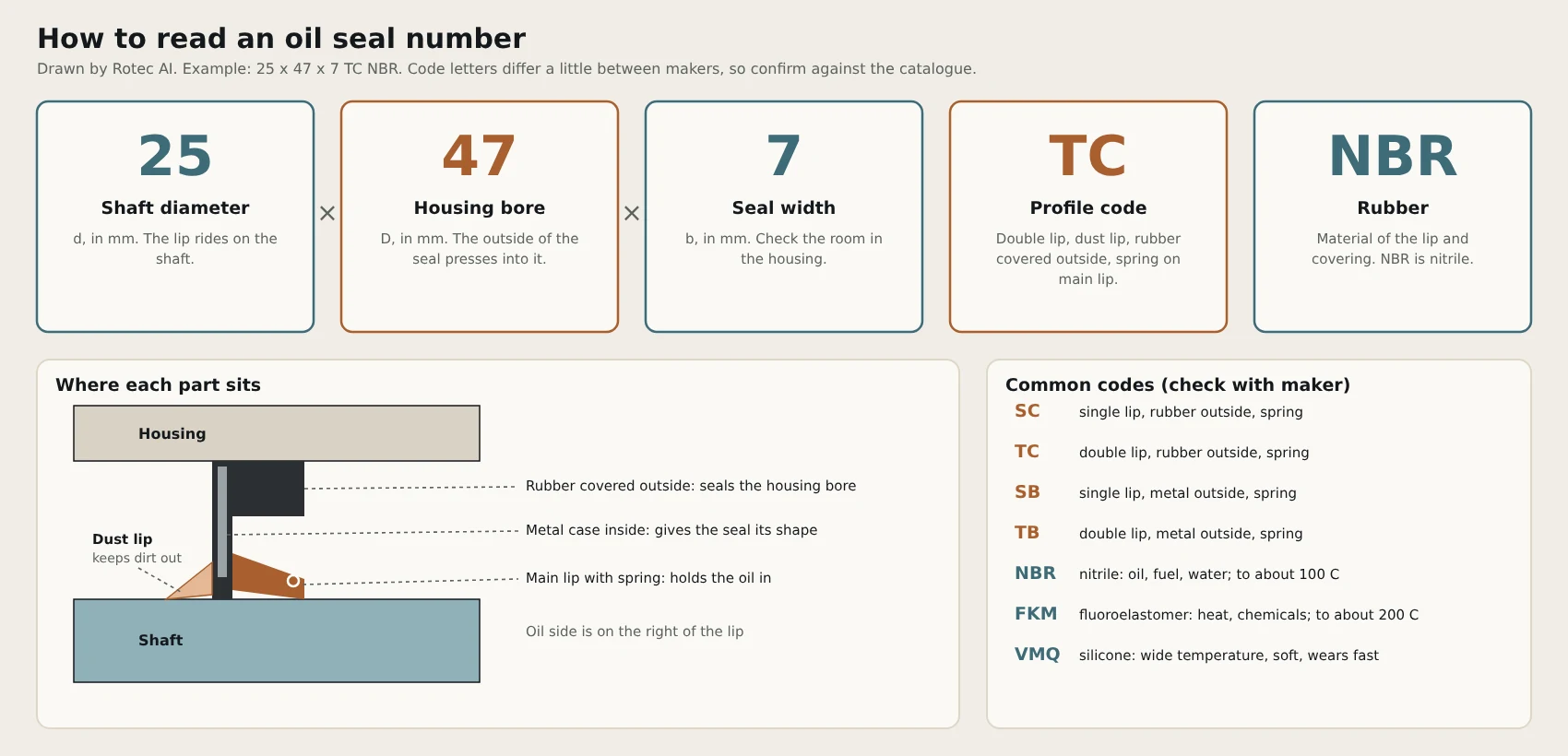
What each part tells you
| Part | Example | Meaning | Where to measure |
|---|---|---|---|
| Shaft diameter (d) | 25 | The shaft the lip runs on, in mm | On the shaft in the clean, unworn area next to the seal track |
| Housing bore (D) | 47 | The bore the outside of the seal is pressed into, in mm | In the housing bore; the seal outside is slightly larger to grip |
| Width (b) | 7 | Seal thickness, in mm | On the seal, and check the depth of the housing |
| Profile code | TC | Lip design and outside construction | By looking at the seal: lips, spring, rubber or metal outside |
| Material | NBR | The rubber of the lips and covering | From the code, or the colour and application if the marking is worn |
Profile codes, and why you should check them
Many catalogues use short letter codes for the lip design. The ones you will meet most often are in the table. The letters are common across makers but not identical, so treat the table as a guide and confirm in the catalogue of the supplier.
| Code | Lips | Outside | Use it when |
|---|---|---|---|
| SC | Single lip with spring | Rubber covered | Clean surroundings; the main job is keeping oil in |
| TC | Double lip with spring (main lip and dust lip) | Rubber covered | Dust, dirt or splash outside; the most common general type |
| SB | Single lip with spring | Metal outside | Housings that are smooth and hard, or where the seal is pressed in often |
| TB | Double lip with spring | Metal outside | As SB, with a dust lip for dirty surroundings |
Common rubber codes
| Code | Material | Good at | Watch for |
|---|---|---|---|
| NBR | Nitrile rubber | Mineral oil, grease, fuel and water; low cost; typical limit about 100 C continuous | Heat above its limit, ozone, strong chemicals |
| FKM | Fluoroelastomer | High temperature (up to about 200 C), many chemicals and synthetic oils | Cost; some amines and hot water or steam; cold flexibility |
| VMQ | Silicone rubber | Wide temperature range, low and high | Soft and wears fast on a dry or rough shaft; poor with many mineral oils, so check the fluid |
| ACM, HNBR, PTFE | Special materials | ACM for hot engine and gear oils, HNBR for tougher conditions, PTFE for speed, heat and chemicals | Often need a harder and smoother shaft; ask the seal maker |
Measuring an old seal
Take the seal out carefully so you do not damage the housing. Measure the outside diameter and the width with a vernier caliper. The shaft size is easier to take from the shaft than from the lip, because the lip shrinks and wears. Write down which side the oil was on and which way the lips face, because a seal fitted backwards will leak or fail quickly.
- Shaft diameter: measure the shaft, not the inside of the used lip.
- Outside diameter and width: measure on the seal at several points and take the average.
- Lip direction: main lip faces the oil; dust lip faces the outside.
- Material: if the marking is worn, use the fluid, temperature and colour (black or brown for NBR, often green or brown for FKM) as clues, then confirm.
Ordering mistakes that cause early leaks
Most early oil seal failures trace back to the fit, the shaft or the handling, not the rubber. Check these before you blame the seal.
- Wrong type for the surroundings: a single lip seal in a dusty area lets dirt reach the lip.
- Wrong material for the fluid or temperature: nitrile on a hot synthetic oil hardens and cracks.
- Shaft track too rough, too soft or grooved by an old seal: use a shaft surface that is hard (about 45 HRC or more) and fine (a typical surface roughness is 0.2 to 0.8 micron Ra), and move the new seal slightly on the shaft if there is a groove.
- Shaft not chamfered or not covered with a sleeve while fitting, so the lip is cut on a keyway or a sharp edge.
- Pressing the seal in at an angle, or by hammering on the lip instead of on the outside edge with a proper driver.
- Running dry at start-up: wipe a little of the system oil or grease on the lip before fitting.
Reading the seal against the machine
Use the code as the start of the order. Then match it to speed, pressure, fluid temperature and the shaft finish. Standard oil seals suit low pressure; for a pressurised housing, a very high speed or a muddy outside, ask the supplier about a pressure type, a PTFE lip or a labyrinth cover. The failure atlas for seals shows what each type of damage means.