

Reliability-centred maintenance and condition monitoring: where each check fits
RCM asks what the machine must do and how it can stop doing it, then picks the cheapest task that deals with each cause. Condition monitoring is the best choice when a failure gives warning.
What RCM is
Reliability-centred maintenance (RCM) is a method for deciding what maintenance each asset needs. It starts from what the machine must do and what the plant can accept, not from what is in the manual. A common standard for it (SAE JA1011) lists seven questions, asked for every important asset.
The seven questions
- What are its functions and the standard of performance required?
- In what ways can it fail to do them (functional failures)?
- What causes each functional failure (failure modes)?
- What happens when each failure occurs (effects)?
- What does each failure matter (consequences: safety, environment, production, cost)?
- What can be done to predict or prevent each failure (tasks)?
- What if no suitable task can be found (default actions)?
The task choices
| Task type | Use it when | Example on a bearing |
|---|---|---|
| Condition-based (on-condition) | The failure gives a warning, and the check can be done in time | Vibration trend and envelope spectrum on a fan bearing |
| Scheduled restoration or replacement | The failure is age-related and the part wears out at a known life | Replace a seal or a grease on a fixed hours basis |
| Failure-finding | A protective device fails silently | Test an overspeed trip or a standby pump |
| Run to failure | The consequences are small and cheap to put right | A low-cost bearing on a spare or non-critical motor |
| Redesign | No task is suitable and the failure is not acceptable | Change the bearing arrangement or add shaft grounding |
Why most tasks should be condition-based
Studies of equipment failure, starting in aviation, found that most failures are not tied to age. A part that has run for a long time is not more likely to fail tomorrow than a part half as old. Replacing parts on a fixed time therefore often adds early-life failures, from assembly errors, without removing the random ones. A check that finds the fault while it is still developing avoids both.
The P-F curve
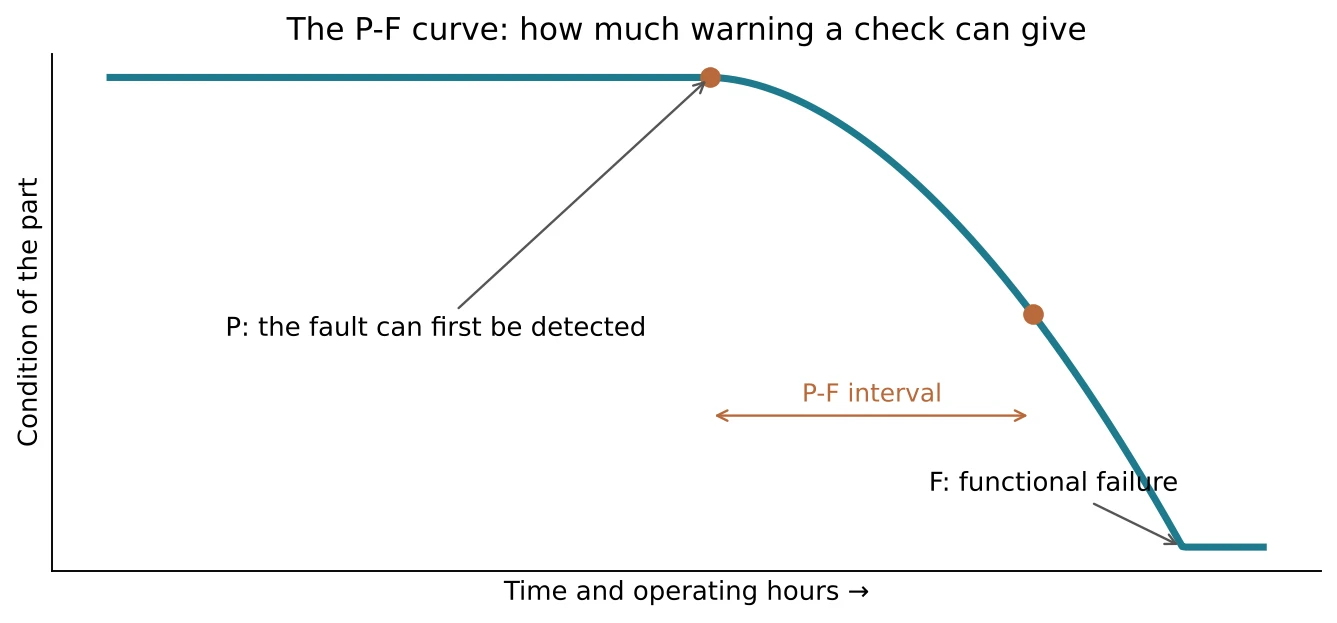
P is the point where a developing fault can first be detected. F is the point where the part can no longer do its job. The time between them is the P-F interval. A check must be repeated at an interval shorter than the P-F interval, and half of it is the usual rule, so that at least one check falls inside the warning period and there is still time to plan the stop.
How the main bearing checks compare
| Check | Warning it gives | Limit |
|---|---|---|
| Ultrasound and envelope analysis | Earliest, weeks to months before the failure | Needs the right band and a known speed |
| Overall vibration trend | Middle, usually weeks | Misses faults in slow or very quiet machines |
| Oil or grease analysis | Middle, shows wear and contamination | Depends on sampling quality and bearing type |
| Temperature | Late, days | Rises only when the damage is already severe |
| Noise and touch | Latest | Subjective, and often too late |
Putting it together
- Rank the machines by what a failure costs, in safety, production and repair.
- For each critical machine, list the failure modes you expect, such as fatigue, contamination, lubricant failure and current erosion.
- Choose the check that sees each one early, and set its interval from the P-F interval.
- Write down the alarm level and the action at each level.
- Record every change and every teardown finding, and use them to correct the intervals.