

Lubrication science
Viscosity index: why an oil that is right at 40 °C can fail at 100 °C
Quick answer
The viscosity index tells you how much an oil thins out when it gets hot and thickens when it is cold.
What it is
Every oil gets thinner as it warms. The viscosity index (VI) is a number from the standard method ASTM D2270 that compares how much the oil changes between 40 °C and 100 °C. A high VI means the viscosity changes less across that range. A low VI means a bigger change.
What it looks like
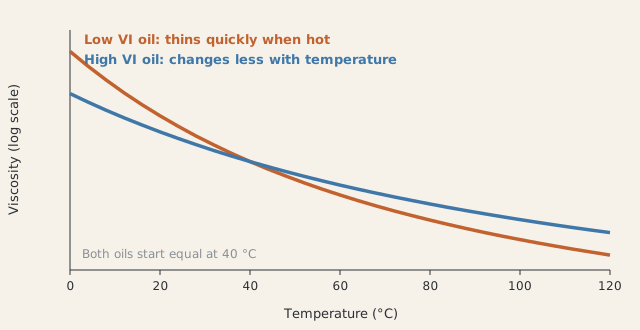
Typical values
| Oil type | Typical VI |
|---|---|
| Group I mineral oil | 80 to 100 |
| Group II mineral oil | 95 to 120 |
| Group III (hydrocracked) | 120 to 150 |
| PAO (Group IV) | 125 to 170 |
| Mineral oil with a VI improver | Above 150 possible |
Why it matters
- Cold start: a low-VI oil can be too thick to flow, so the bearing runs dry for the first seconds.
- Hot running: a low-VI oil can thin until the film breaks and wear starts.
- A wide swing in temperature, such as an outdoor fan or a mobile machine, needs a high VI.
- A machine that runs at one steady temperature needs less VI, and a well-chosen ISO grade may do the job.
How to use it
- Choose the grade by the viscosity needed at the operating temperature, not only at 40 °C.
- Compare VI when you compare two oils of the same ISO grade.
- Remember a high VI from a polymer additive can fall if the polymer shears. See the viscosity index improver topic.
Takeaway. VI tells you how steady the oil film will be across your temperature range. For a wide range, choose a high-VI oil, and check the viscosity at the real operating temperature.
Put it to work in the tool