

Lubrication science
Contamination: the biggest cause of lubricant failure
Quick answer
Dirt, water, air and chemicals: where they come from, what size does the damage, and how to stop them.
Four kinds
| Type | Examples | Effect |
|---|---|---|
| Solid particles | Dust, sand, wear debris, rust, seal fragments | Abrasive wear, surface denting, fatigue |
| Water | Condensation, leaks, washdown | Rust, oxidation, additive loss, a broken film |
| Air and gas | Entrained air, foam, leaks in suction lines | Oxidation, cavitation, spongy hydraulics |
| Chemicals and other fluids | Coolant, fuel, process fluids, the wrong oil | Additive attack, seal damage, viscosity change |
Particle size and damage
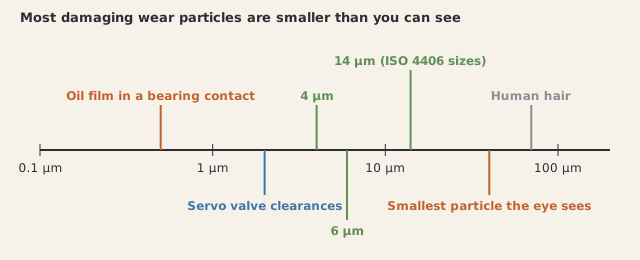
Size against effect
| Particle size | What it does |
|---|---|
| Above 100 µm | Visible. Can block passages and cause severe scoring. |
| 25 to 100 µm | Cause wear and shorten component life. |
| 5 to 25 µm | Cause surface fatigue and spalling in bearings and gears. |
| 1 to 5 µm | Polish surfaces, increase wear and clog fine filters. |
| Below 1 µm | Build up as sludge and affect the oil film slowly. |
Where it comes from
- External entry: through seals, breathers, hatches and open top-up.
- Internal generation: wear debris, oxidation sludge and varnish.
- Operating factors: high temperature, wrong lubricant, poor maintenance.
- Human factors: dirty containers, funnels and tools, poor storage.
Control strategy
- Fit good seals and desiccant or filtered breathers.
- Filter the oil to a set cleanliness target and keep the filters in good condition.
- Use closed, labelled, dedicated transfer equipment.
- Clean the area before opening a housing or filler.
- Flush new systems before commissioning.
- Check cleanliness with sampling and trend it.
- Train everyone who handles lubricant.
Takeaway. Stop dirt and water at the entry points, filter to a target, and measure. Cleaner oil gives longer component life than any other single change.
Put it to work in the tool