

Condition monitoring
2X running speed or 2 times line frequency? Telling mechanical from electrical
Quick answer
On an induction motor a line near 100 Hz can be 2X running speed, 2 times line frequency or both. These checks separate them.
The overlap
| Motor | Running speed (50 Hz supply) | 2X running speed | Line frequency ×2 |
|---|---|---|---|
| 2-pole | about 49.2 to 49.8 Hz | about 98.4 to 99.6 Hz | 100 Hz |
| 4-pole | about 24.6 to 24.9 Hz | 4X is about 98.4 to 99.6 Hz | 100 Hz |
The two lines sit only a fraction of a hertz to a couple of hertz apart, so the first test is spectrum resolution.
Ways to separate the two
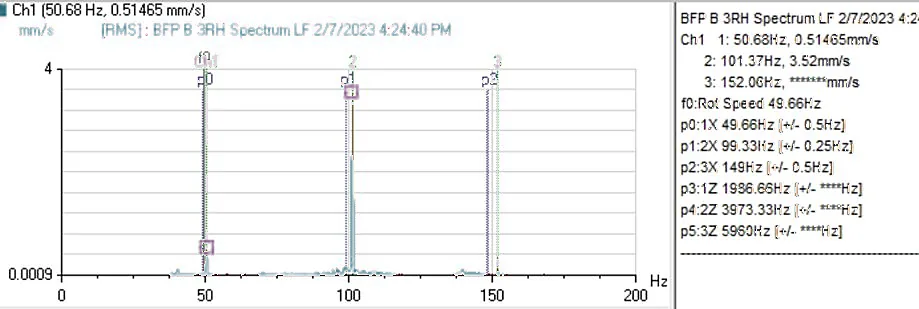
- Zoom the spectrum so that the resolution is finer than the 0.5 to 1 Hz gap between the lines. At 99.3 Hz and 100 Hz they are separate lines.
- Change the load. Running speed moves with load because of slip. Line frequency does not move.
- Cut the power and watch the line as the motor coasts down. Electrical lines vanish at once, mechanical ones fall with speed.
- Do a dynamic soft foot test, which affects the mechanical cause and the foot-induced distortion of the air gap.
What each means
- 2X running speed high: misalignment, particularly parallel, or looseness.
- 2 times line frequency high: electrical, such as stator eccentricity or loose windings, or soft foot that distorts the frame.
- Both together: check alignment and soft foot first, then electrical.
A practical case
Fifteen boiler feed pumps shared a spectrum with high 2X and 2 times line frequency. Alignment ignored thermal growth, and soft foot had not been checked. The author read the 2X line as parallel misalignment and the 2 times line frequency line as soft foot.
Takeaway. Resolution, load change and a run-down separate 2X from 2 times line frequency. Check soft foot and alignment first.
Put it to work in the tool