

Condition monitoring
Phase analysis and motion amplification: showing where a machine really moves
Quick answer
Phase tells you which parts move together and which move against each other. Motion amplification shows it as a video. Together they find a loose pedestal that a spectrum alone only hints at.
What phase tells you
| Phase pattern | Meaning |
|---|---|
| Same phase across a joint | The parts move together, the joint is stiff |
| About 180° across a joint | The two sides move against each other: a loose or flexible joint |
| 90° between horizontal and vertical at one bearing | A typical sign of unbalance |
| Axial readings 180° apart across a coupling | Angular misalignment |
Where it earns its place
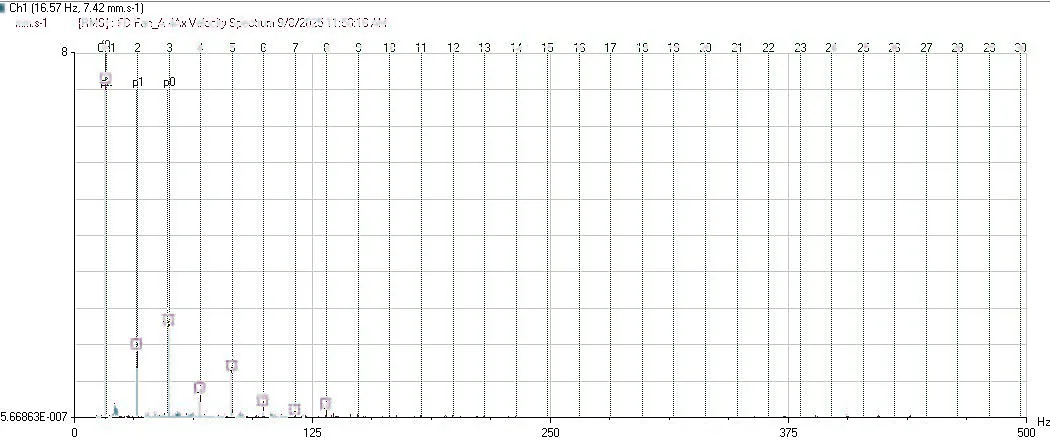
A forced-draught fan had its highest reading in the axial direction. The spectrum had harmonics but the time waveform had no impacts. The plant had planned a new rotor. Phase analysis is the technical way to find the parts that move out of step. Motion amplification video showed where and how the movement occurred, at the non-drive-end pedestal. The pedestal was bolted down and fixed, and axial vibration fell from 8.3 to 1.8 mm/s RMS.
What motion amplification is
- A video technique that magnifies very small movements, often a few thousandths of a millimetre, until they are visible.
- It lets you see a rocking pedestal, a flexing base or a pipe that moves.
- It is also a communication tool: people who do not read spectra believe what they see.
Limits
- It shows motion, not the cause. A loose bolt and a cracked grout may look the same.
- It needs light, a steady camera and a view of the machine.
- It is slower and more costly than a vibration reading. Use it where the answer changes the repair.
A working order
- Spectrum: find the dominant line.
- Waveform: rule out impacts.
- Phase: find the parts that move out of step.
- Video, if needed: show the owner.
- Fix, then measure again.
Takeaway. Phase finds the loose joint, a video makes it visible. A bolting job can replace a rotor.
Put it to work in the tool