

Why a normal overall vibration level can hide an early bearing or gear fault
A report that reads 2.1 mm/s RMS and NORMAL can still hide a developing defect. The overall number adds up everything in a band, and a small repeating fault adds almost nothing to it.
The report that looks fine
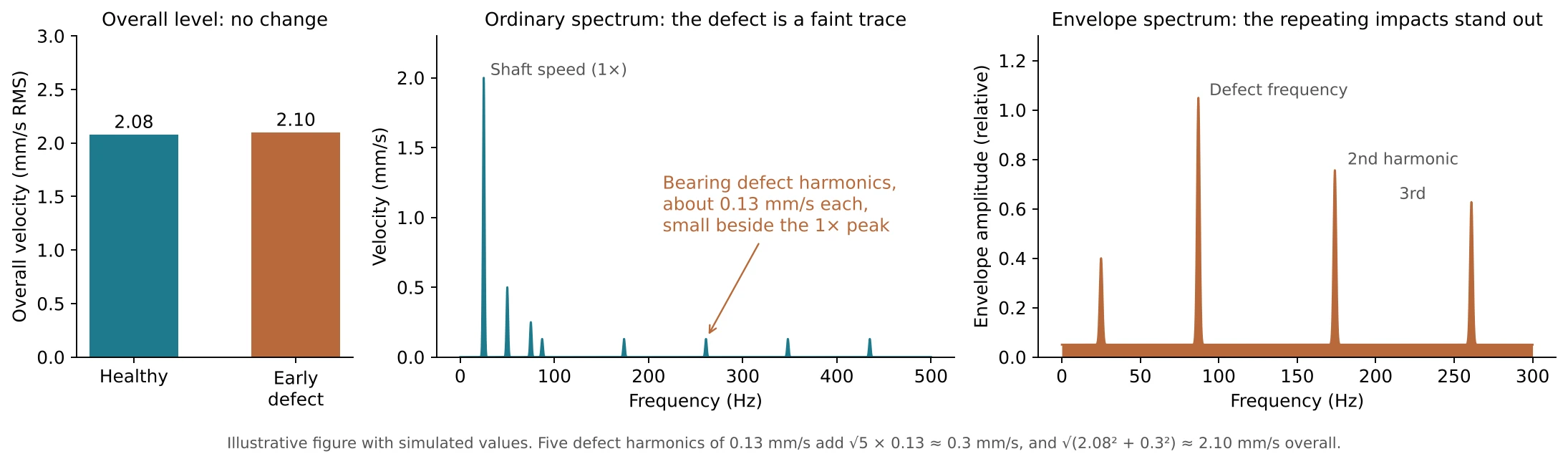
A machine's vibration report shows an overall level of 2.1 mm/s RMS and an alarm status of normal. The level is under the limit, so the machine looks acceptable. It may not be. An early bearing defect or a developing gear fault can sit underneath that number without changing it.
Why the overall level misses it
The overall level is the combined energy in one measurement band, for example 10 to 1,000 Hz. Quantities add in quadrature, not in a straight line, so a large component hides a small one. A strong 1× peak at 2.08 mm/s and a bearing defect that adds 0.3 mm/s in total give an overall level of about 2.10 mm/s. The defect changed the headline number by about 1%. Early-stage defects are small, local and repeating, so they put energy into narrow peaks and high-frequency impacts, not into the overall number.
What a skilled analyst looks at next
| Method | What it shows | Typical early-fault use |
|---|---|---|
| FFT spectrum | Fault frequencies, harmonics and sidebands | Bearing and gear fault frequencies, 1× and 2× faults |
| Time waveform | Repeating impacts and sudden events | Spalls, loose parts, rubbing, gear tooth damage |
| Envelope analysis | The repetition rate of impacts hidden in high-frequency vibration | Early rolling bearing defects |
| High-frequency analysis | Acceleration well above the usual velocity band | First signs of bearing and gear wear |
| Trend | Change over days and weeks | Small steady rise before any alarm limit is reached |
How to build this into the programme
- Do not rely on the overall velocity alone for any critical rolling-bearing or gearbox machine.
- Add band alarms and an envelope or high-frequency parameter to every routine reading.
- Set an alarm on the change from the baseline as well as on the absolute level.
- Take a full spectrum and waveform at each visit on critical machines, and keep them for comparison.
- When the trend of any parameter turns, take a closer measurement before the overall level moves.
What to tell the customer
Meeting the overall acceptance criteria shows the machine is not in trouble now. It does not show that no defect has started. A report that gives only the overall level and an alarm colour should say so, and say what else was checked.