

Condition monitoring
Linear or log scale: why a 5 mm/s harmonic disappears beside a 109 mm/s peak
Quick answer
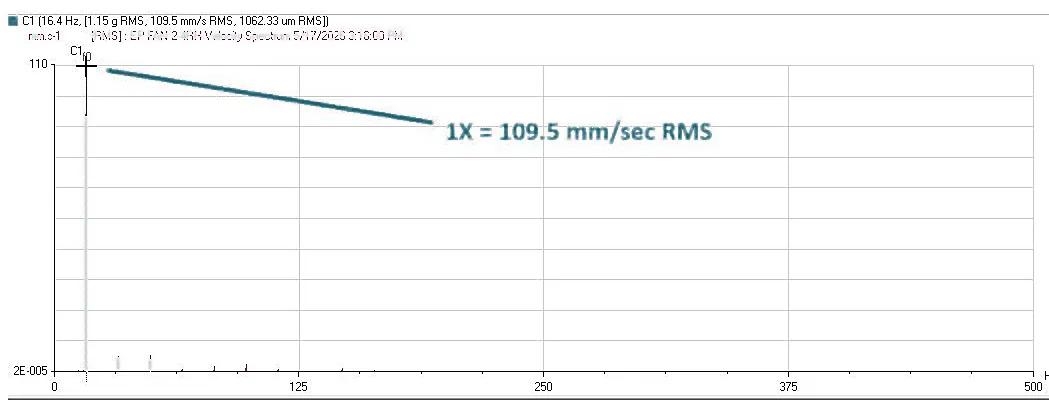
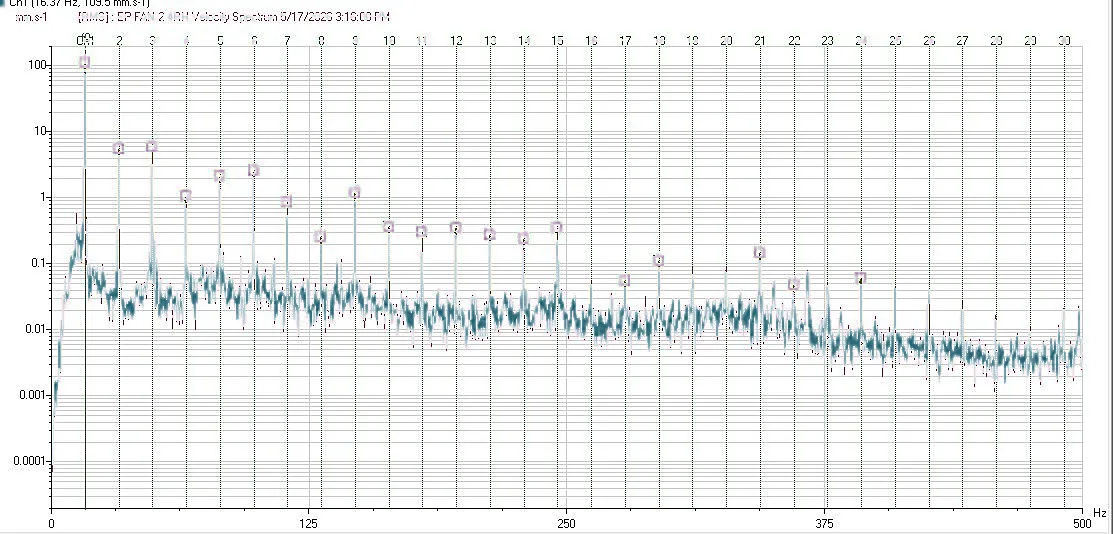
On a linear amplitude scale, a huge 1X line makes everything else look flat. On a log scale the harmonic ladder that marks looseness shows clearly. Switching the scale is the cheapest diagnostic step there is.
The problem
If the biggest line is 109.5 mm/s RMS, a 5.5 mm/s line at 2X is 5 per cent of the height. On the screen that is a small spike beside a tall tower. On a log scale each tenfold change takes the same height, so lines of 100, 10 and 1 mm/s are evenly spaced.
What a harmonic ladder means
| Pattern | Likely cause |
|---|---|
| 1X only, nothing above | Unbalance or a bent shaft |
| 1X plus many whole-number harmonics | Looseness: structural, in the fits or in the bearing seat |
| Half-order lines (0.5X, 1.5X) as well | Severe looseness or rubbing |
| Harmonics with sidebands | Modulation: a bearing or gear fault on top of looseness |
How to use the log scale
- Flip the scale after you have read the linear spectrum, not instead of it. The linear view is the one that shows severity.
- Count the harmonics above the noise. More than four or five clear orders is a looseness warning.
- Use the harmonic cursor so you can check that the lines fall exactly at whole multiples of 1X.
- Compare the horizontal and vertical at the same bearing. A ratio of four or five to one adds to the evidence.
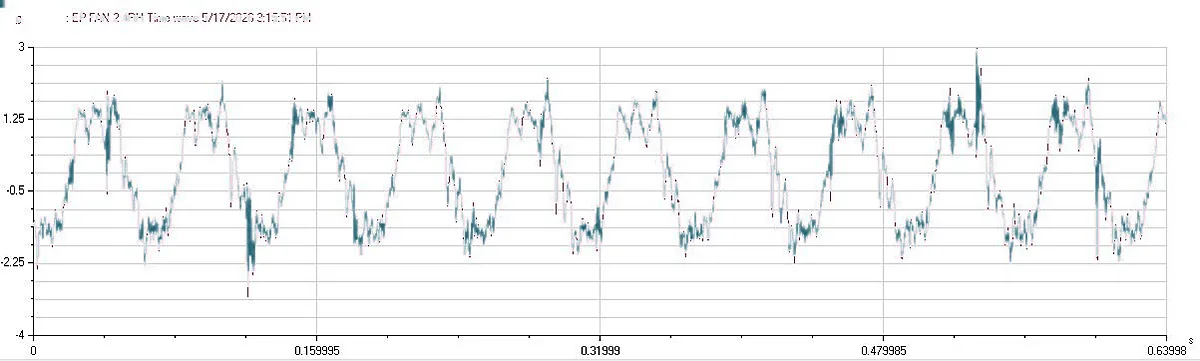
Takeaway. Always look at the log scale when 1X is huge. A harmonic ladder is looseness until shown otherwise.
Put it to work in the tool