

Condition monitoring
Beating: when two machines at nearly the same speed make a 1X that rises and falls
Quick answer
A level that swells and fades every few seconds is not always an unstable machine. Two sources running a fraction of a hertz apart add up and drop out of step, giving a predictable slow cycle.
What beating is
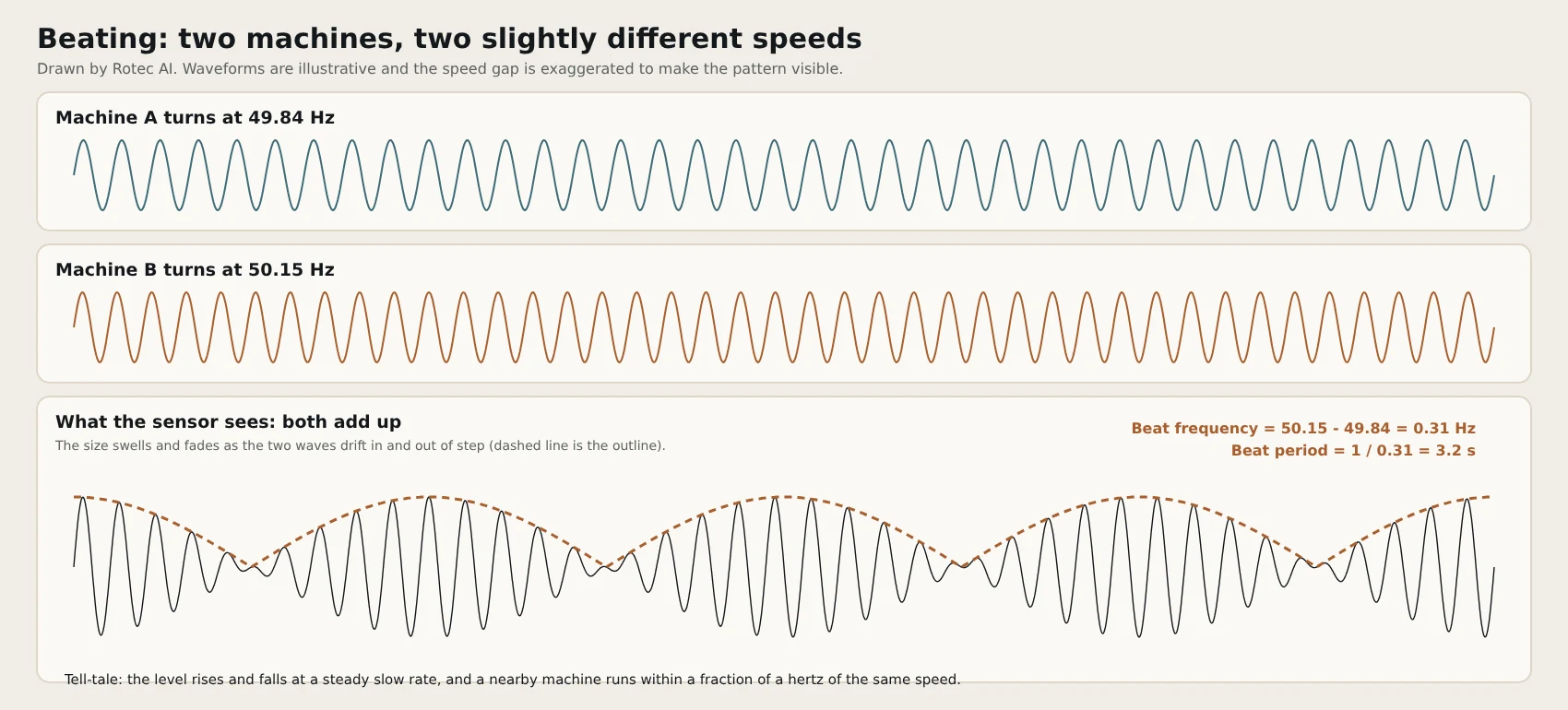
Beating appears when two vibration sources have slightly different frequencies. Their waves drift in and out of step. When they line up the total is the sum of the two, and when they oppose each other it is the difference. The combined level rises and falls at the difference frequency.
The arithmetic
| Item | Example |
|---|---|
| Source A | 50.15 Hz |
| Source B | 49.84 Hz |
| Beat frequency | 50.15 − 49.84 = 0.31 Hz |
| Beat period | 1 ÷ 0.31 = 3.2 seconds |
How to spot and confirm it
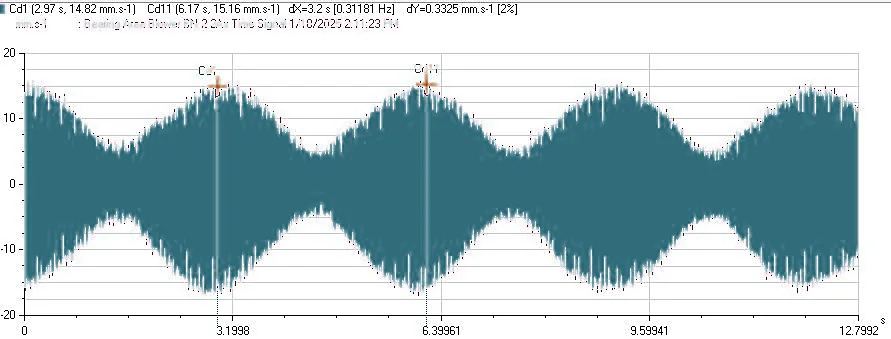
- A slow regular swell in the live reading: cycle of seconds.
- Two lines in the spectrum less than 1 Hz apart. You need fine resolution to see both.
- A waveform long enough for four cycles. For a 3.2 s period set at least 13 s.
- Stop one of the machines if you can. The swell stops.
Why it matters
- It can be mistaken for an unstable machine and lead to wasted work.
- It means the two machines share a structure, so each one adds to the other's reading. A fix on one lowers both.
- Alarm limits that look at the peak of the swell can trip on a machine that is fine.
Takeaway. Beat frequency is the difference between the two speeds. If it matches the period you see, you have beating.
Put it to work in the tool