

Condition monitoring
Alignment that holds when the machine is hot: thermal growth, soft foot and fits
Quick answer
Alignment done cold can be wrong when the machine runs hot. Fifteen boiler feed pumps lost bearings within ten months until thermal growth was included. When alignment will not hold at all, the cause may be a loose bearing fit.
Three reasons good alignment fails
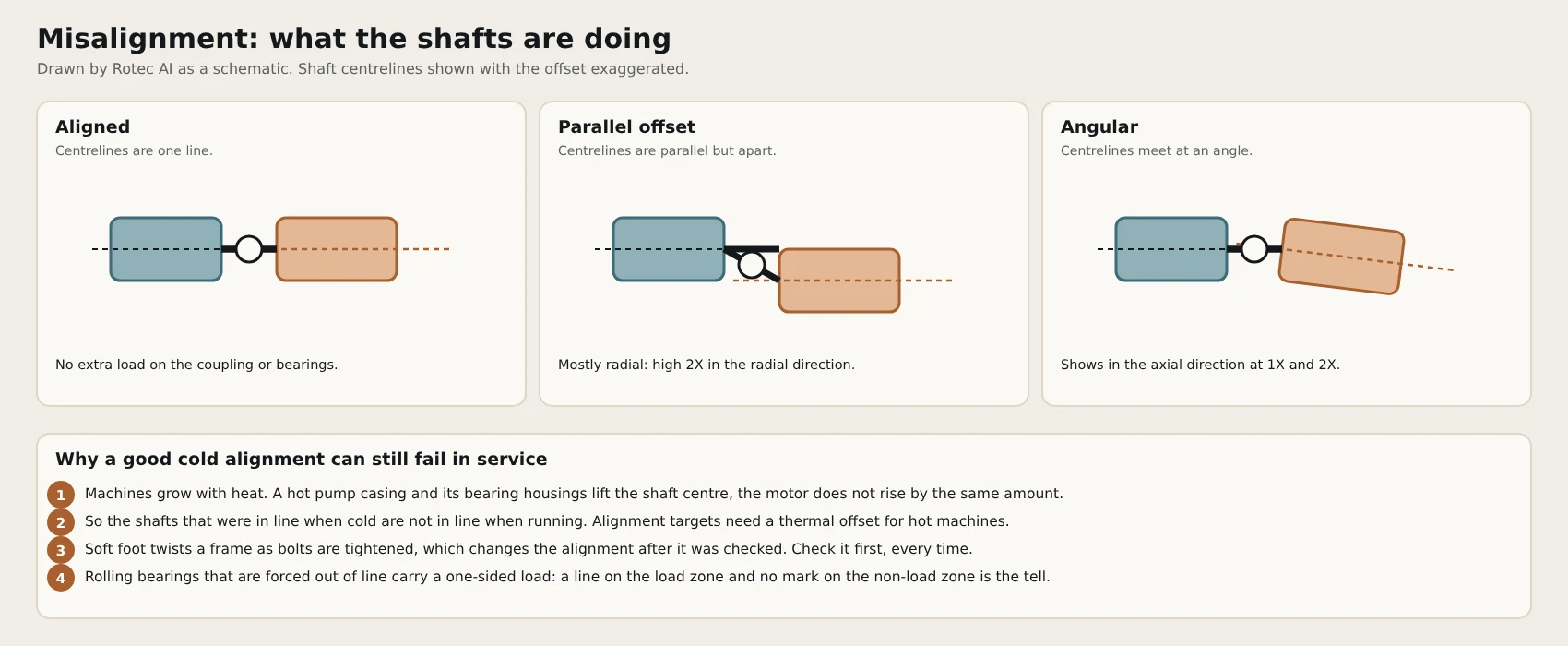
- Thermal growth. A hot pump and a cooler motor move their shaft centres by different amounts, so cold-aligned shafts are out of line when running.
- Soft foot. Frames twist when tightened, which changes the alignment after it was checked.
- Loose fits. A bearing that moves on its seat cannot hold a shaft in place, so every correction is lost.
What the data shows
| Misalignment type | Direction | Spectrum |
|---|---|---|
| Parallel | Radial | High 2X, sometimes 1X and 3X |
| Angular | Axial | High 1X and 2X in the axial direction |
| Gear mesh affected | All round the box | High first gear mesh line |
What an old bearing can tell you
A one-sided wear track, a distinct line on the load zone and no mark on the non-load zone, shows the bearing carried a steady one-sided load. That is what misalignment does. A bearing that has moved on its seat shows fretting marks on the ring.
A working order
- Check soft foot at every foot, every time.
- Align with the thermal offset for that machine. Take the figure from the maker or from a hot-to-cold measurement.
- Check the bearing fits and housing bores if alignment will not hold.
- Run the machine and measure again, including the 2X and the axial readings.
- Open one old bearing and read the wear track.
A case with all three
A roughing mill gearbox kept losing alignment. The cause was a fretted bearing fit, which also explained the short pinion life. The case is in the cases list.
Takeaway. Include thermal growth, check soft foot first, and look at the fits when alignment will not hold.
Put it to work in the tool