

Lubrication science
Base oil groups I to V: what the API classification means
Quick answer
A lubricant is mostly base oil. The five API groups describe how pure it is and how it behaves.
The idea
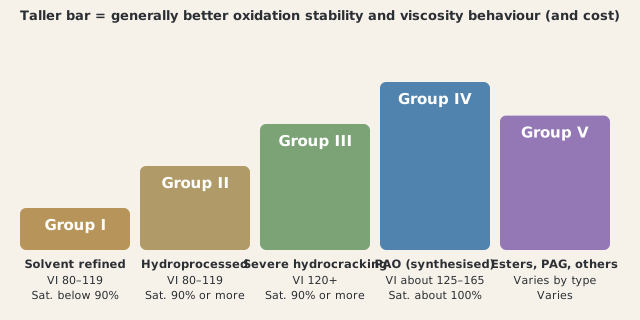
Most of a finished oil is base oil, often 70 to 99 percent. The additives are only the rest. The American Petroleum Institute sorts base oils into five groups by how much saturated hydrocarbon and sulphur they contain, and by their viscosity index.
Groups at a glance
Comparison
| Group | Made by | Saturates / sulphur | Viscosity index | Typical use |
|---|---|---|---|---|
| I | Solvent refining | Below 90% saturates and/or above 0.03% sulphur | 80 to 119 | General industrial oils, many greases |
| II | Hydrotreating (hydroprocessing) | 90% or more saturates, 0.03% sulphur or less | 80 to 119 | Hydraulic, industrial and gear oils, engine oils |
| III | Severe hydrocracking | 90% or more saturates, 0.03% sulphur or less | 120 or more | Long-life engine oils, many synthetic-grade industrial oils |
| IV | Chemical synthesis (polyalphaolefin, PAO) | About 100% saturates, no sulphur | About 125 to 165 | Extreme-temperature gear, bearing and compressor oils, greases |
| V | Everything else: esters, polyalkylene glycols and others | Varies | Varies | Special duties: biodegradable, fire resistant, very hot or cold |
Typical properties (indicative)
| Property | Group I | Group II | Group III | Group IV (PAO) |
|---|---|---|---|---|
| Pour point, °C | 0 to -15 | -15 to -30 | -30 to -45 | -50 to -60 |
| Flash point, °C | 180 to 210 | 200 to 220 | 220 to 240 | 240 to 260 |
| Oxidation stability | Fair | Good | Very good | Excellent |
| Relative cost | Low | Medium | Medium to high | High |
How to choose
- Extreme cold or heat, or very long drain intervals: look at Group IV or V.
- General industrial duty where cost matters: Group I or II is usually enough.
- Wet, hot or heavy duty greases: the base oil matters as much as the thickener.
- Do not rank on group alone. Additives, viscosity and the maker's approval decide the fit.
Why you meet this on site
Data sheets often say "mineral", "semi-synthetic" or "synthetic". Group III oils are sold as synthetic in some markets and as mineral in others, so check the data sheet or ask the supplier what the base stock actually is.
Takeaway. The group tells you the purity and the viscosity behaviour of the base oil. It is a starting point for choosing a lubricant, not a quality score.
Put it to work in the tool