

Pump bearings: arrangement, loads, failure causes, fits and mounting
A centrifugal pump shaft is held by one fixed bearing that takes axial load and one float bearing that lets the shaft grow. Most pump bearing failures trace back to lubrication, contamination, overload, underload or misalignment, and the pump running away from its best efficiency point is behind many of them.
The sections below cover each cause, how to read the marks on the ring, how to measure and fit, and how slurry duty changes the picture.
How a centrifugal pump shaft is held: fixed bearing, float bearing and drive
Why pump bearings are different from general machine bearings, which bearing holds the shaft, which one floats, and what the drive adds.
What a pump bearing has to do
- Keep axial movement of the shaft to a minimum.
- Keep radial deflection to a minimum.
- Hold the right running clearance between the impeller and the casing.
One bearing holds, one floats
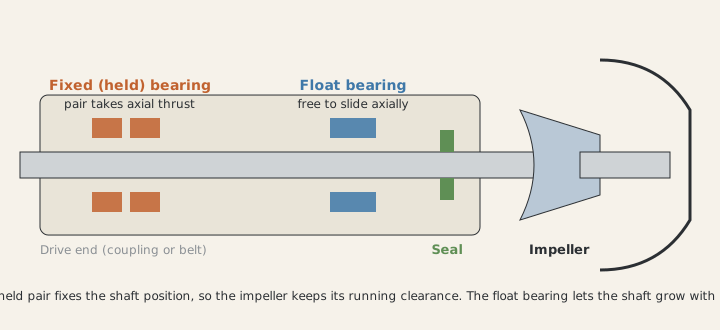
The two jobs
| Position | Usual bearing | Why |
|---|---|---|
| Fixed (held) bearing | Angular contact pair, or a double row angular contact bearing | Takes radial load and axial thrust and sets the shaft position, so the impeller clearance stays correct |
| Float bearing | Cylindrical roller bearing | Takes radial load only; the rings slide axially so the shaft can grow with heat without binding |
| Why not two fixed bearings | - | Two fixed bearings fight the shaft growth, overload each other and run hot |
How the pump is driven
- Direct coupling, rigid or flexible.
- Indirect drive through a belt.
- A belt pulls the shaft harder than a flexible coupling does. A flexible coupling pulls less, and better motor-to-pump alignment reduces that pull further.
Common speeds
| Pump size or type | 60 Hz supply | 50 Hz supply |
|---|---|---|
| Large end-suction and split-case pumps | 1,200 rpm | 1,000 rpm |
| Medium-sized pumps | 1,800 rpm | 1,500 rpm |
| Smaller process pumps | 3,600 rpm | 3,000 rpm |
Takeaway. A pump shaft is held by one fixed bearing that takes axial load and one floating bearing that lets it grow. Check that the arrangement still matches that picture after any rebuild.
Pump bearing types: angular contact, double row and cylindrical roller
What each common pump bearing does, how contact angle, cage and pairing change the result, and how to read a typical designation.
Single row angular contact ball bearing
| Feature | What it means in a pump |
|---|---|
| Role | Usually the fixed bearing |
| Loads | Radial load and axial load in one direction only |
| Contact angle | 15, 25, 30 or 40 degrees. A higher angle gives more axial and less radial capacity, and a lower speed limit |
| Cage | Machined brass as standard, also steel, polyamide or phenolic |
| Setting | Runs with clearance or with preload. Preload gives high rigidity |
Pairing two bearings
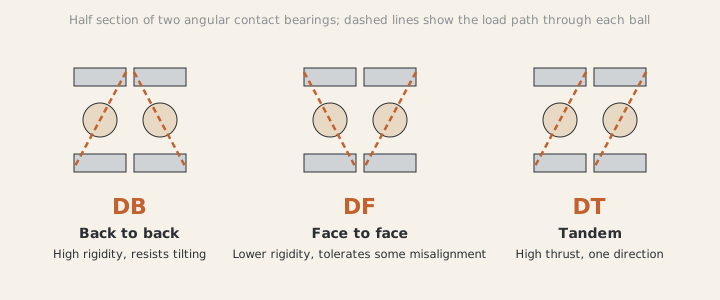
Duplex pairs compared
| Pair | Name | Effect |
|---|---|---|
| DB | Back to back | High rigidity, resists tilting, takes axial load both ways |
| DF | Face to face | Lower rigidity, tolerates some misalignment, takes axial load both ways |
| DT | Tandem | High thrust capacity in one direction (the pair shares the load) |
Double row angular contact ball bearing
| Feature | What it means |
|---|---|
| Role | Usually the fixed bearing |
| Build | Equivalent to two single row bearings mounted back to back |
| Radial capacity | About 1.7 times a single row bearing |
| Standard and maximum-capacity versions | The maximum-capacity version has a filling slot, which can limit its axial capacity |
| Axial load | Both directions for the standard version |
| Sealing | Open or sealed |
Cylindrical roller bearing
| Feature | What it means |
|---|---|
| Role | Usually the float bearing; the rings can move axially |
| Capacity | High radial capacity and good speed capacity |
| Cage | Machined brass as standard, also steel, polyamide or phenolic. Brass cages are often relieved for strength and have pockets that guide the rollers |
Cage material and temperature
| Cage material | Long-term limit | Short-term limit |
|---|---|---|
| Polyamide 66 | about 120 °C | about 150 °C |
| Polyamide 46 | about 150 °C | about 180 °C |
| PPS | about 190 °C | about 220 °C |
| Machined brass | Used across a wide range of pump service | Check the catalogue |
Reading a typical designation
Take 7305 B M as an example. 73 is the series, 05 is the bore code (multiply by 5 for a 25 mm bore), B means a 40 degree contact angle and M means a machined brass cage. Further suffixes set tolerance class, clearance or preload and differ between makers, so read the catalogue for them. Bearings ground for pairing ("universal" bearings) can be mounted in any pair arrangement and come with a small axial clearance in the 8 to 12 micrometre range or a slight preload.
Clean steel and heat treatment
Double row angular contact bearings made from high-purity steel with special heat treatment are reported to last 2 to 4 times longer than standard steel in the same duty, and some carry a 40 degree contact angle for more axial stiffness. Ask your supplier for the data on the exact bearing.
Takeaway. Pick the fixed bearing by its axial load direction and the float bearing by radial load, then match the cage to the temperature and the pair arrangement to the rigidity you need.
Where pump bearing loads come from: weight, coupling, belt and hydraulics
The four load sources on a pump shaft, why hydraulic load is lowest at the best efficiency point, and what to do about it.
Four load sources
| Source | What it does |
|---|---|
| Mass of the impeller and shaft | Steady downward load, always there |
| Coupling or belt | A belt drive pulls harder than a flexible coupling. Good motor-to-pump alignment reduces the coupling load |
| Hydraulic radial load | Unequal fluid velocity around the casing pushes the impeller sideways. Casing design and the piping both influence it |
| Hydrostatic and momentum forces | Pressure and flow of the pumped fluid push the shaft along its axis |
Hydraulic load and the best efficiency point
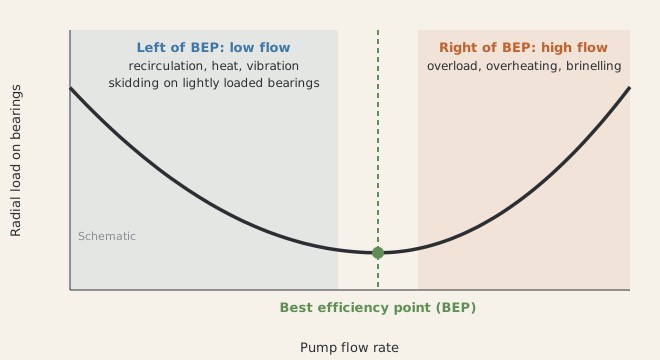
What changes away from the best point
- The hydraulic radial load grows and changes direction.
- Left of the best point (low flow) the pump recirculates, heats up and vibrates, and lightly loaded bearings can skid.
- Right of the best point (high flow) the loads and temperatures rise and brinelling marks can form.
- A closed or throttled valve pushes the pump left of the best point.
What to do
- Operate close to the best efficiency point, and ask whether the pump is oversized.
- Avoid running against a closed valve.
- Check belt tension and coupling alignment after every rebuild.
- Look at pipe strain on the casing before blaming the bearing.
Takeaway. The hydraulic load is lowest at the best efficiency point, so the cheapest bearing upgrade is often to move the operating point back towards it.
Pump bearing failures from lubrication and contamination
What too little, too much and dirty lubricant leave on the ring, with photographs of flaking, water marks and particle denting.
Lubrication causes and effects
| Cause | Effect |
|---|---|
| Lack of lubricant | More friction and wear |
| Oil level or grease amount not maintained | Premature failure |
| Too much lubricant | More friction |
| High oil level or too much grease | More torque and roller skidding |
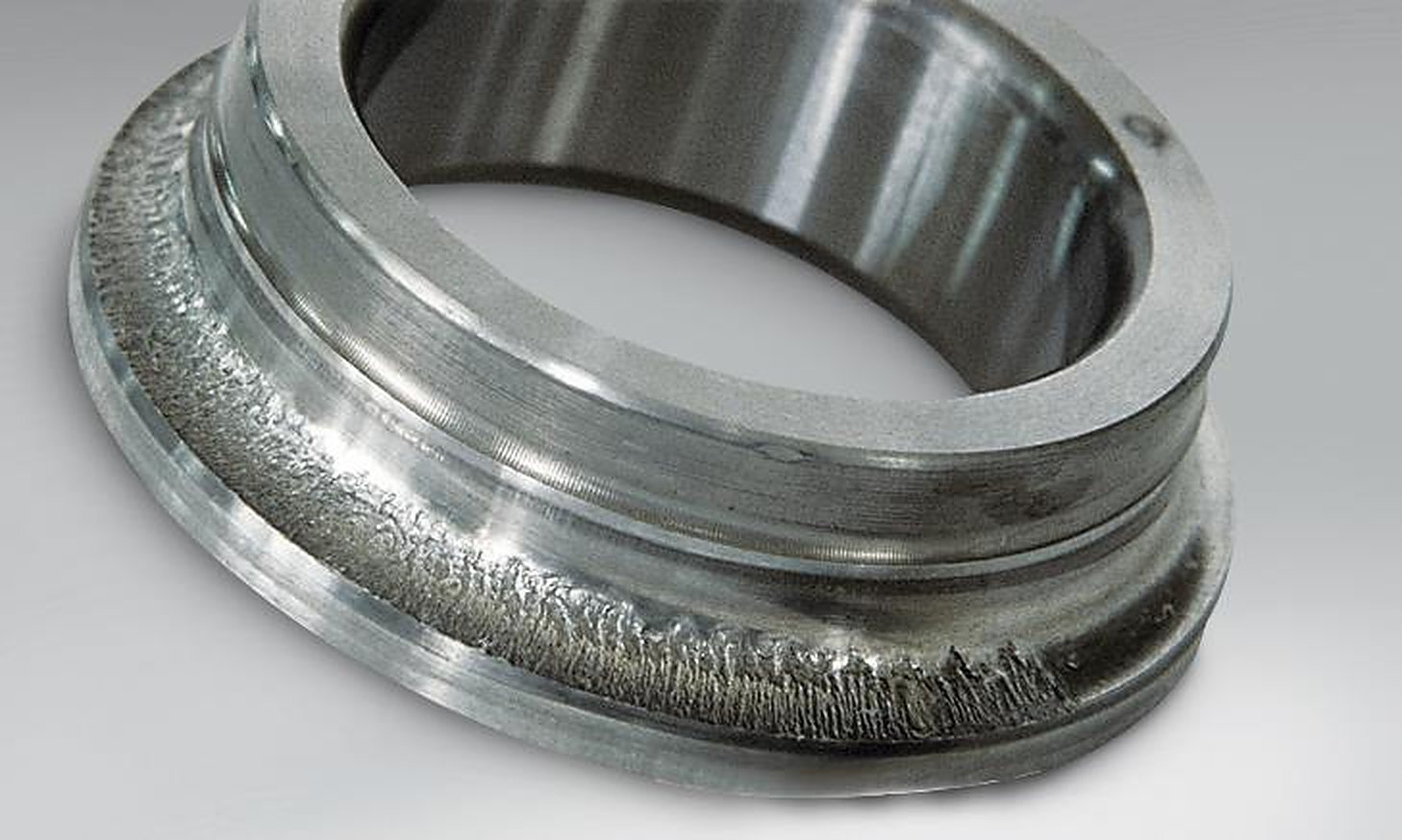
Flaking on a ring edge
Contamination causes and effects
| Cause | Effect |
|---|---|
| Environment | Water and corrosive fluids reach the bearing |
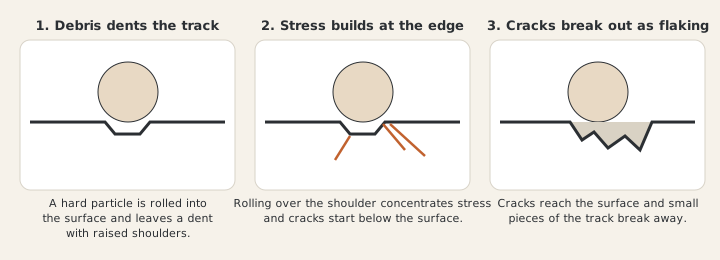
| Sealing too weak | Contamination gets in, and hard particles dent the raceways |
| Storage | Bearings kept in open containers or packages pick up dirt before they are fitted |
Water in the bearing
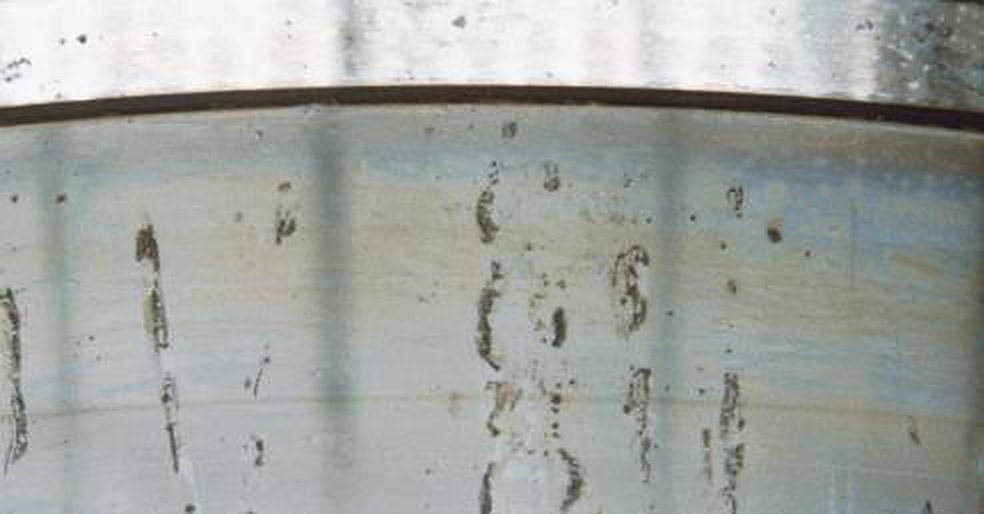
How much water is too much
A common cause of pump bearing failure is water. The amount that counts as contamination depends on the type of grease and its water content limit, so check the grease data sheet and keep the water out in the first place.
Particle denting
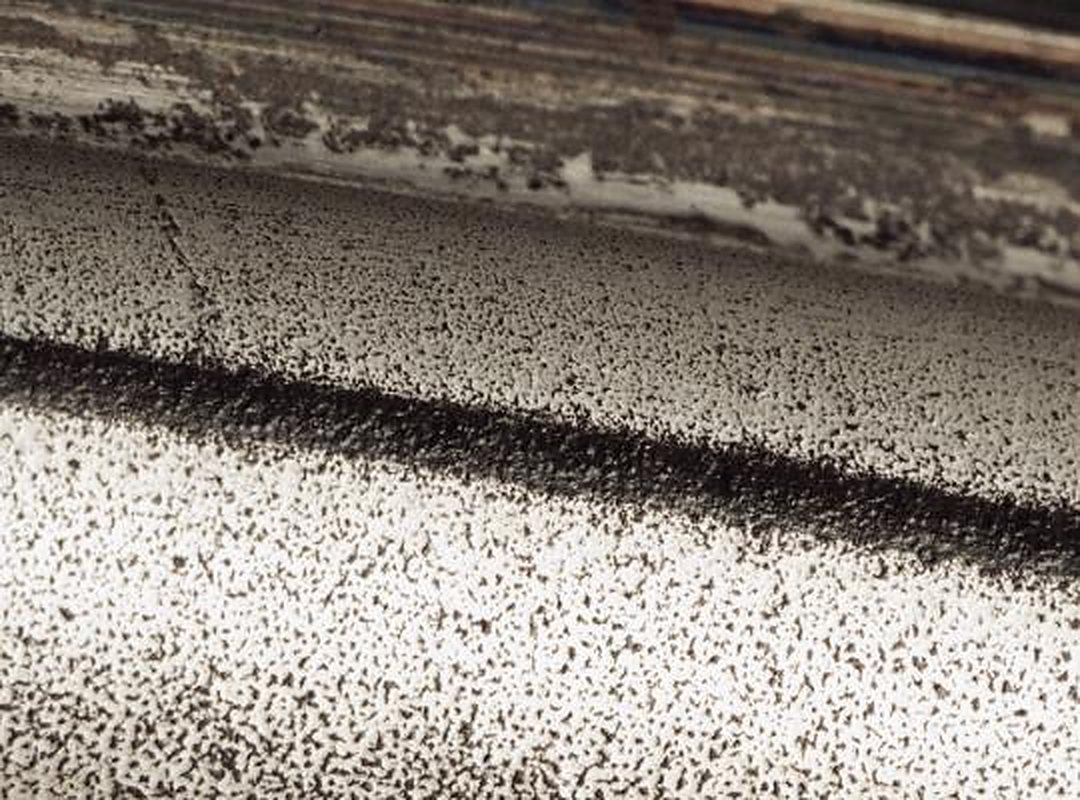
Takeaway. Dirty, wet or wrongly filled lubricant shows up on the ring as flaking, water bands or fields of tiny dents. Fix the seal and the fill, not just the bearing.
Pump bearing failures from overload, underload and misalignment
How running right or left of the best point, belt tension, soft foot and pipe strain damage a pump bearing, with photographs.
Overloading
| Cause | Effect |
|---|---|
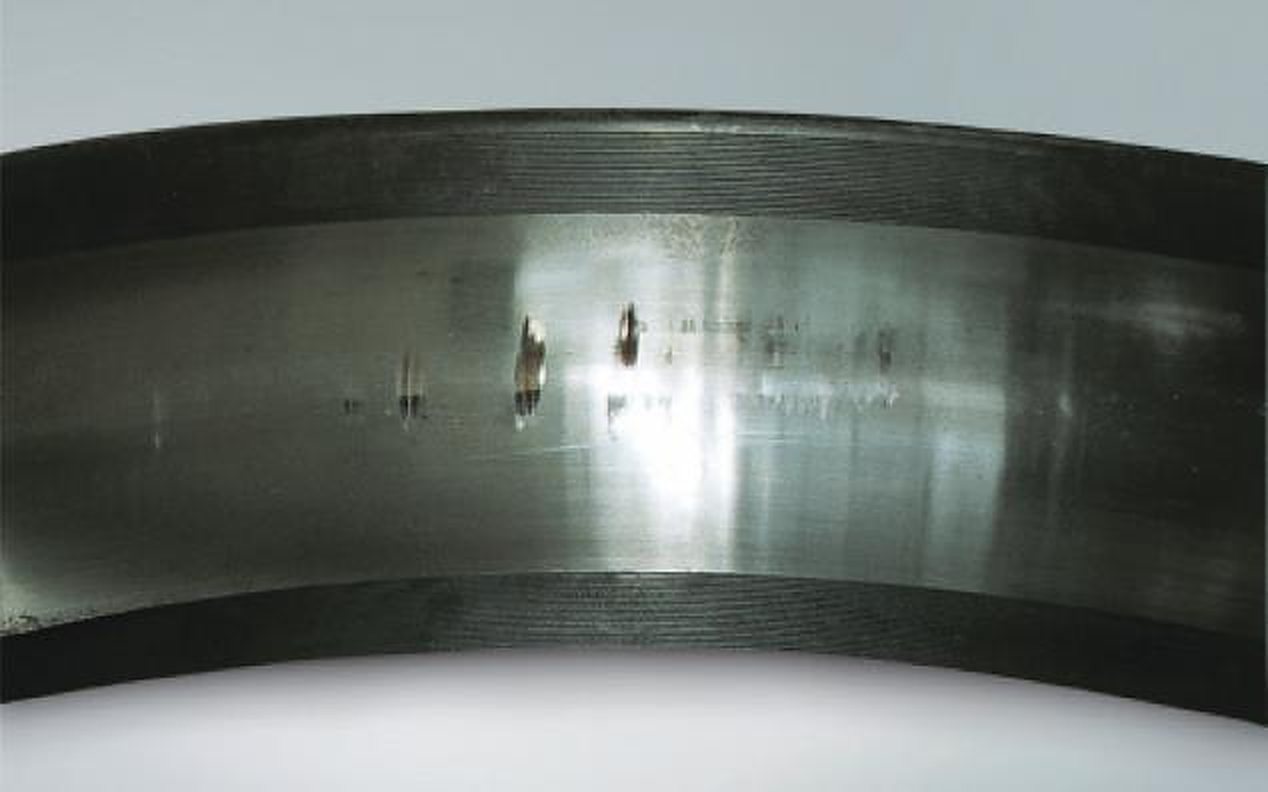
| Running the pump right of the best efficiency point | Overheating and brinelling |
| Belt tension too high | Unplanned preload on the bearing |
Overload marks
Underloading
| Cause | Effect |
|---|---|
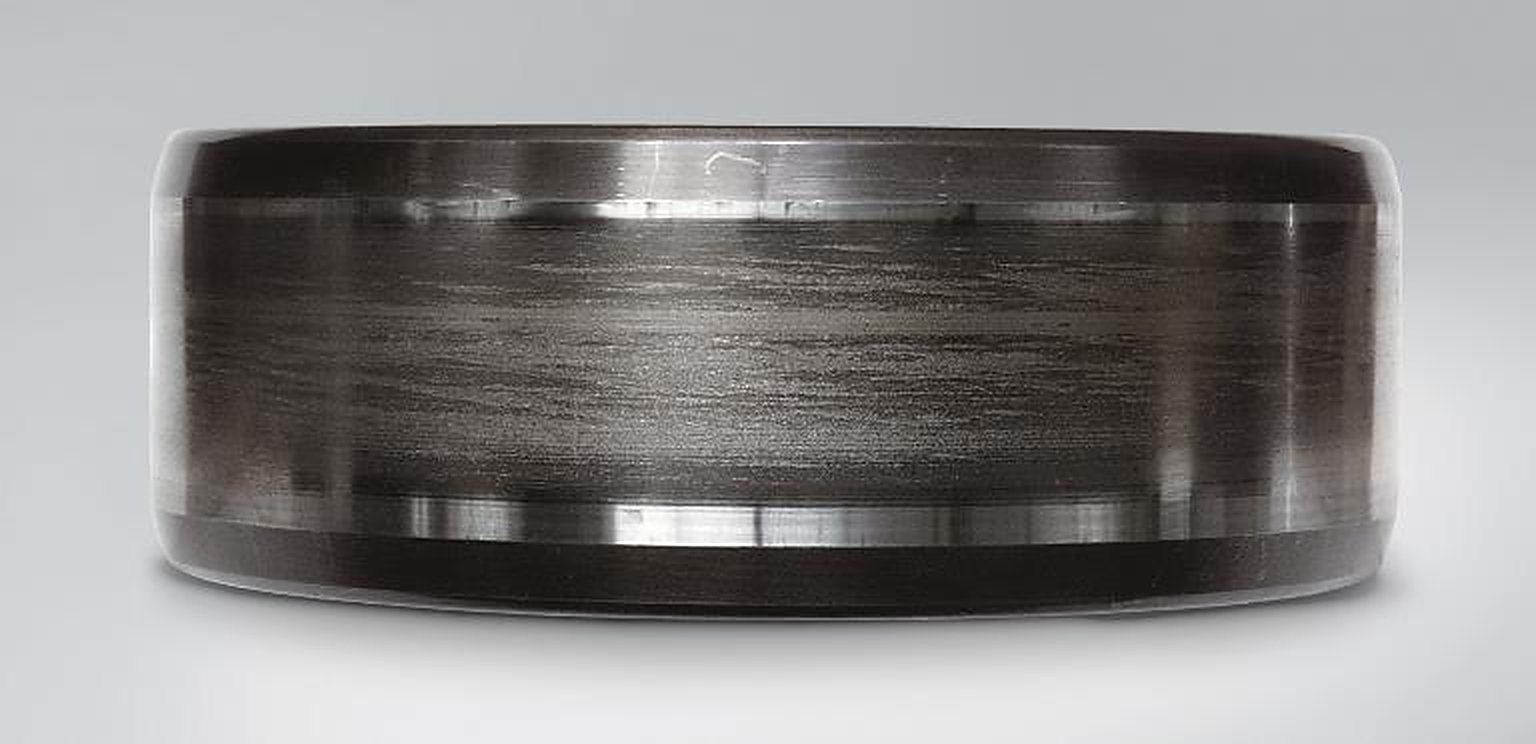
| Running the pump left of the best efficiency point | Overheating, brinelling and skidding |
| Closed valves | Recirculation and vibration |
Skidding marks
Alignment and installation
| Cause | Effect |
|---|---|
| Motor to pump misalignment | More vibration |
| Installation base (soft foot) | Cage damage |
| Piping strain on the casing | Distorted housings and casings, impeller rubs and vibration |
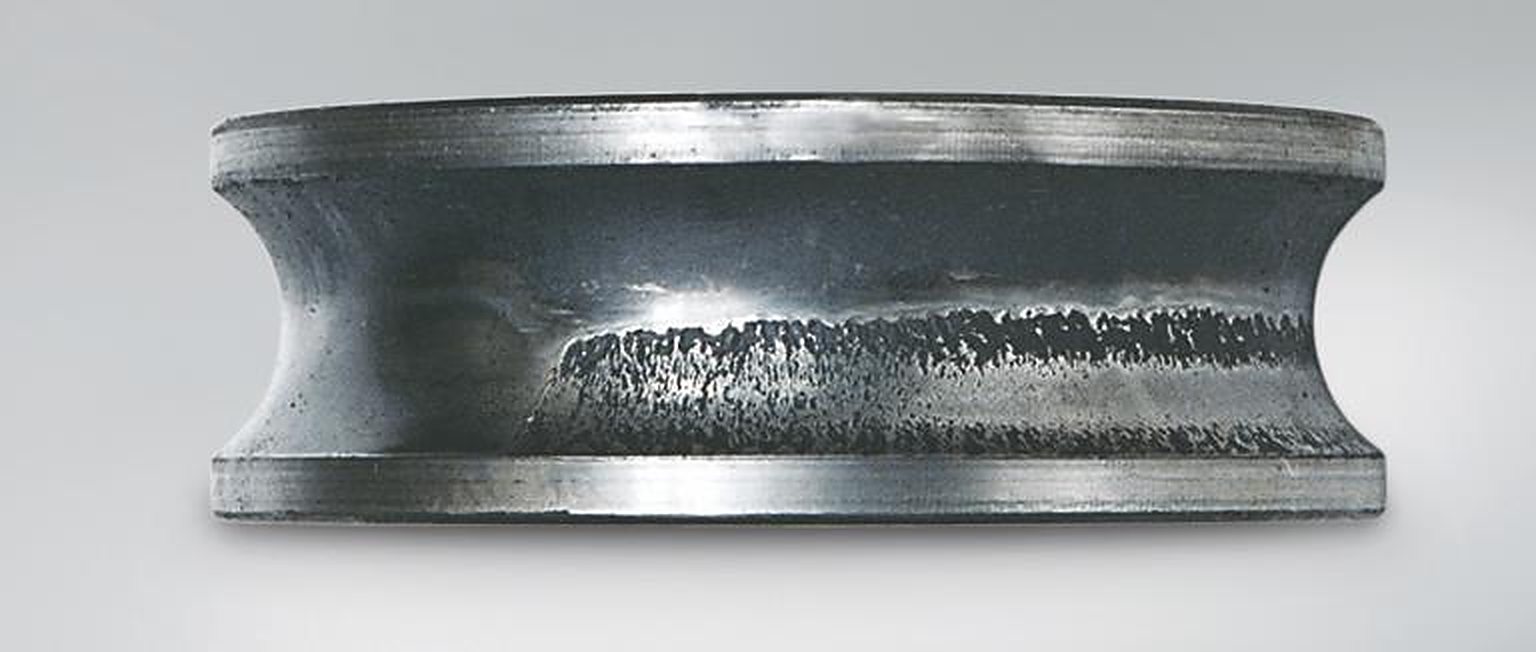
Load biased to one side
Check order
- 1. Is the pump running near its best efficiency point?
- 2. Is the valve open and the flow steady?
- 3. Is the belt tension right, or the coupling aligned?
- 4. Is the base flat (soft foot) and the pipe free of strain?
Takeaway. Overload, underload and misalignment each leave a recognisable mark. Read the mark, then fix the operating point, the alignment or the base before replacing the bearing.
Lubricating and sealing a pump bearing housing
Grease, oil bath, oil ring and oil mist compared, and why a labyrinth seal usually outlasts a radial lip seal.
Lubrication methods
| Method | How it works |
|---|---|
| Grease | Sealed in the bearing or injected into the pump cavity |
| Oil bath | The rolling elements run through an oil reservoir in the housing |
| Oil ring | A ring on the shaft rotates through the oil bath and flings oil onto the bearing |
| Oil mist | Atomised oil droplets are sprayed into the housing with compressed air |
What a shaft seal must do
- Keep solid and liquid contaminants out of the bearing.
- Keep the lubricant in.
Two common seals
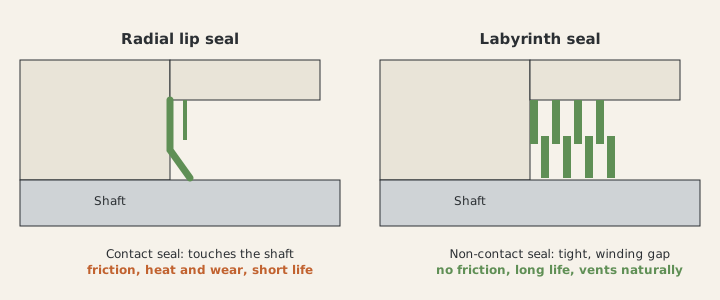
Radial lip and labyrinth compared
| Radial lip seal | Labyrinth seal | |
|---|---|---|
| Contact with shaft | Yes | No |
| Friction and heat | Can be high, depending on the lubricant and the shaft finish | Little or none |
| Typical life | Short, about 2,000 to 4,000 hours | Long |
| Venting | No | Breathes naturally |
| Watch for | Wear on seal and shaft | Water spray and dust packing the gap |
Takeaway. Keep the fill right, and prefer a non-contact labyrinth where water allows. A lip seal is a wear part with a short, predictable life.
Fits and measuring the shaft and housing before you fit a pump bearing
Which fit to choose, when to go tighter or looser, and how to measure the shaft and housing bore in four places.
Shaft fit
- Interference fit between the inner ring and the shaft.
- Use a heavier fit than normal if the bearing sits on a hollow shaft or a sleeve.
- Use a lighter fit than normal if the shaft is stainless steel and the inner and outer rings run at very different temperatures.
Housing fit
- A slight clearance between the outer ring and the housing so the float bearing can move.
- Use a looser fit for large bearings where the outer ring and housing run at different temperatures.
Measure before you mount
- Measure the housing bore and the shaft diameter in 4 places: top to bottom, side to side, front and back.
- Record the inboard and outboard readings at 90 and 180 degrees, then work out the difference and the amount over the limit.
Example wear limits (illustrative)
| Part | Size range (mm) | Fit window (mm) | Wear limit (mm) |
|---|---|---|---|
| Housing bore | 120 to 150 | +0.043 to +0.143 | 0.230 |
| Housing bore | 150 to 180 | +0.043 to +0.143 | 0.250 |
| Housing bore | 180 to 250 | +0.050 to +0.150 | 0.260 |
| Housing bore | 250 to 315 | +0.056 to +0.156 | 0.270 |
| Shaft journal | 80 to 120 | -0.036 to -0.071 | 0.110 |
| Shaft journal | 120 to 180 | -0.043 to -0.083 | 0.130 |
How to use the table
These limits come from one training deck and show how a shop limit sheet is laid out. Use your own plant standard or the bearing maker's fit tables for real decisions.
Takeaway. Measure the shaft and the housing in four places before every bearing change. A worn seat undoes a good bearing.
Removing and mounting pump bearings safely
What not to hit a bearing with, how to prepare the work area, and why force must go through the ring being fitted.
Safe handling
- Never hit a bearing with a hammer. Bearing steel is hard and brittle and fractures on impact, and sharp pieces can fly.
- Do not use torches, hammers, brass rods or chisels to remove a bearing.
- Use a puller, a hydraulic method or an induction heater designed for the job.
Prepare the work area
- Clean the area where bearings are installed: dirt, grinding dust, dirty rags.
- Clean the shaft, the housing and every part before it enters the build-up area.
- Make sure all the parts are there, including nuts, bolts, seals and O-rings.
- Check the shaft and housing for burrs, nicks and surface damage, and check diameter, roundness, fillet and shoulder height.
Press on the ring being fitted
| Practice | Result |
|---|---|
| Pushing on the loose ring while the tight-fit ring goes on | Wrong: the force travels through the balls and can dent the raceways |
| Pressing the ring that has the tight fit | Correct |
| Pressing inner and outer rings at the same time with a tool that spans both | Correct, when both rings are a tight fit |
Takeaway. Clean work area, measured seats and force through the ring being fitted. The three habits that stop most installation damage.
Slurry pump bearings: contamination, vibration and a case that went from 2-3 months to a year
Why slurry duty is harsher on bearings, how a dent turns into flaking, and a reported case that stretched bearing life.
Why slurry is hard on the bearing stack
- A slurry pump moves a mixture of solids and liquid.
- The slurry adds vibration and contamination to the bearing stack.
From dent to flaking
Tough steel for contaminated duty
- Special bearing steel with a heat treatment aimed at surface-initiated failure is offered for dirty duty.
- The supplier figure is about twice the life under contaminated conditions.
- It extends the maintenance interval but does not replace good sealing.
Reported case
| Item | Detail |
|---|---|
| Machine | Slurry pump with angular contact bearings |
| Main cause of failure | Contamination, with poor installation as the other common mode |
| Change | Switched to a tough-steel bearing |
| Life before | 2 to 3 months |
| Life after | About 1 year |
| Reported saving | About USD 60,000 |
Reading the case
The figures are as reported by the site and the supplier. Your own saving depends on downtime cost and on whether the real cause, contamination and installation, is fixed too.
Takeaway. In slurry duty the life limit is dirt, not load. Seal first, install carefully, then consider a tough-steel bearing.
Questions
Why does a centrifugal pump use one fixed and one float bearing?
The fixed bearing sets the shaft position so the impeller keeps its running clearance. The float bearing lets the shaft grow with heat without binding.
Which bearing types are common in pumps?
Angular contact ball bearings (single or paired), double row angular contact bearings and cylindrical roller bearings. The first two usually hold the shaft; the cylindrical roller usually floats.
What does running left or right of the best efficiency point do to bearings?
Running left (low flow) causes recirculation, heat, vibration and skidding. Running right (high flow) raises loads and temperature and can cause brinelling. Radial load is lowest at the best efficiency point.
What is the most common cause of pump bearing failure?
Contamination is a leading cause, especially water, together with lubrication problems. Seals and clean handling prevent most of it.
Should I use a lip seal or a labyrinth seal?
A radial lip seal contacts the shaft and typically lasts 2,000 to 4,000 hours. A labyrinth seal does not touch the shaft, adds little friction and typically lasts much longer.
How do I measure a shaft or housing before fitting a bearing?
Measure in four places: top to bottom, side to side, front and back, at inboard and outboard positions, then compare the difference with the wear limit for your standard.
Related: All bearing failure modes · Damage names explained · Bearing Autopsy · Open the Pump bearings guide in the tool